Mariana Rocha UI/UX Designer | Portfolio

Menu
Better You: An Emotional Wellness Companion
My role
Product Designer
Platform
Mobile app prototype
Main Tools
Figma, Paper, Lovable, Landbot, Maze, ChatGPT and Claude.
Better You is a conceptual mobile app exploring how conversational technology can support emotional self-awareness through guided conversations, mood tracking, and daily well-being activities.
As the sole Product Designer, I led the project from research and concept validation to prototyping and usability testing. The process included surveys with 29 participants, three rounds of usability testing, and an unmoderated prototype test with 21 users.
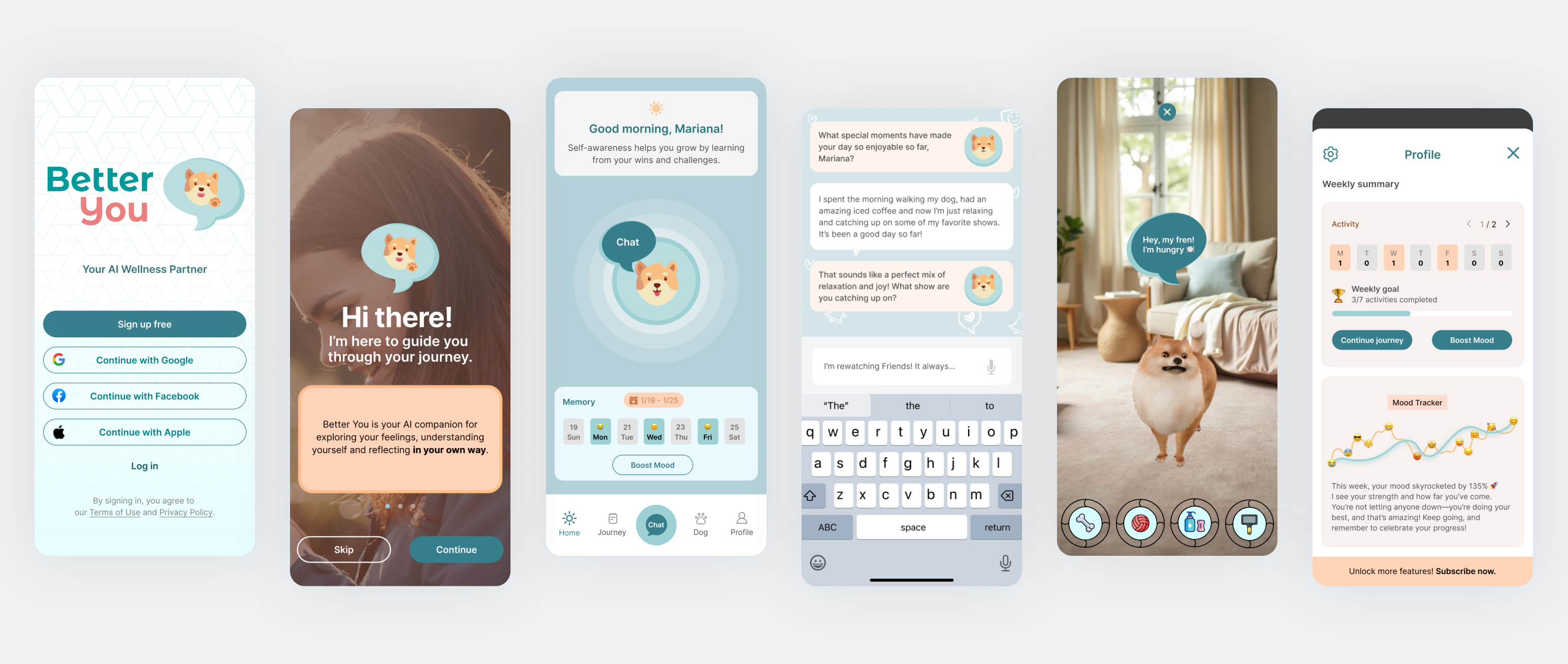
The final experience combines a conversational chatbot, mood journal, virtual pet mascot, and daily challenges. While the chatbot helps users reflect through supportive conversations, the virtual pet creates engagement through playful interactions like feeding, grooming, and playing, encouraging consistent self-care habits.
Key skills: UX Research | UI Design | Conversation Design | Prototyping | Usability Testing
Intro
As AI becomes increasingly part of our daily lives, I wanted to explore how emerging technologies could create more meaningful and supportive digital experiences.
With many people turning to AI for emotional support, there is an opportunity to design tools that go beyond general-purpose conversations. Better You explores how a purpose-built AI companion can encourage self-reflection, emotional awareness, and healthier daily habits through a more engaging and human-centered experience.
My goal as a Product Designer was to create an accessible and intuitive experience shaped by user research, usability testing, and mental health best practices. The focus was not to replace professional support, but to create a companion that helps users better understand their emotions and develop self-awareness.
Challenge: Creating a more supportive digital experience for emotional well-being
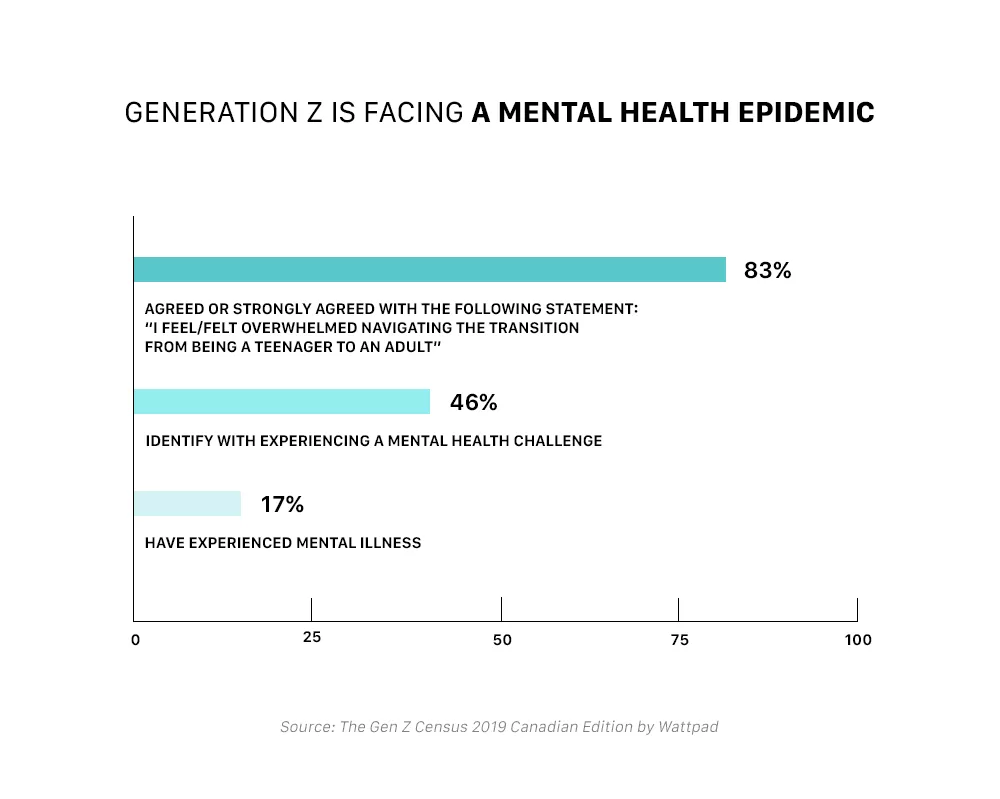
Accessing mental health support can be challenging due to cost, availability, and long waiting times. As mental health concerns continue to rise, technology has the opportunity to complement traditional care by providing accessible tools that encourage emotional awareness and self-reflection.
At the same time, many people are already turning to AI for emotional support. However, most general-purpose AI assistants were not designed for mental health conversations. While they can provide helpful responses, they may lack the structure, personalization, and safeguards needed to support users through emotional challenges.
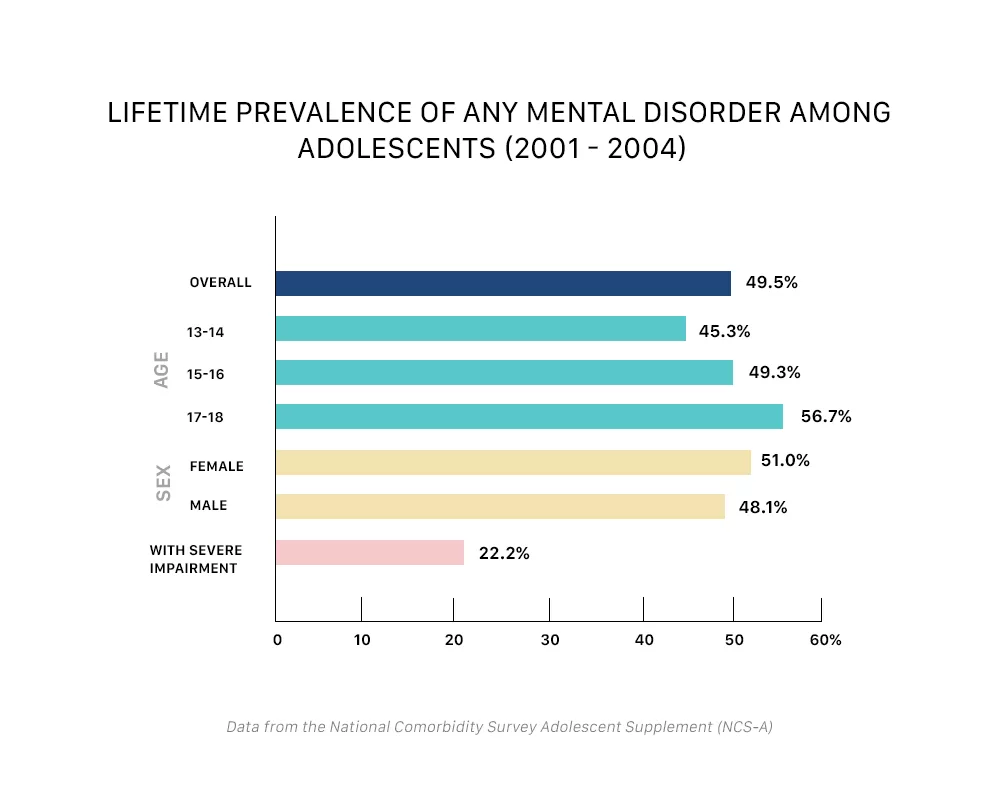
Research shows that around 15% of young people aged 10–19 experience mental health disorders, and more than 60% of youth with major depression do not receive the support they need. These challenges highlight the opportunity to design AI experiences that are not only accessible, but also more intentional, supportive, and aligned with mental health best practices.
This led to the core design question: How might we create an AI companion that helps users better understand their emotions, develop self-awareness, and build healthier habits through a more personalized and supportive experience?
The opportunity: Designing safer digital support experiences
As more people turn to AI for emotional support, conversations around safety and responsible design become increasingly important. Research from the APA highlights that AI-generated guidance should be approached carefully and should be aligned with research-backed therapeutic approaches rather than replacing professional care.
However, chatbots are becoming more accepted as a complementary tool. More than half of psychologists (54%) reported feeling comfortable with some patients using chatbots, especially when these tools are designed with psychological research and expertise in mind. When used appropriately, they may help users practice therapeutic exercises, reflect on their emotions, and explore new perspectives.
This research reinforced the opportunity to design a more intentional conversational experience focused on self-awareness, reflection, and healthy habits, while creating a supportive tool that complements, not replaces, professional mental health care.
Approach: Designing for self-awareness and engagement
Based on this opportunity, I explored how a digital experience could help users better understand their emotions, reflect on their feelings, and build healthier habits.
I conducted user research through surveys, concept validation, and usability testing to understand users’ expectations, concerns, and behaviors around emotional support. These insights informed the design of a mobile experience combining a conversational chatbot, mood tracking, a virtual pet mascot, and daily well-being challenges.
To validate the concept, I conducted unmoderated usability testing with a diverse group of users, observing their interactions, identifying usability issues, and measuring task completion across three wireframes and two digital prototypes.
The findings helped refine the user flow, conversation experience, and overall product experience through continuous iteration.
Research & Discovery
1. Understanding existing wellness experiences
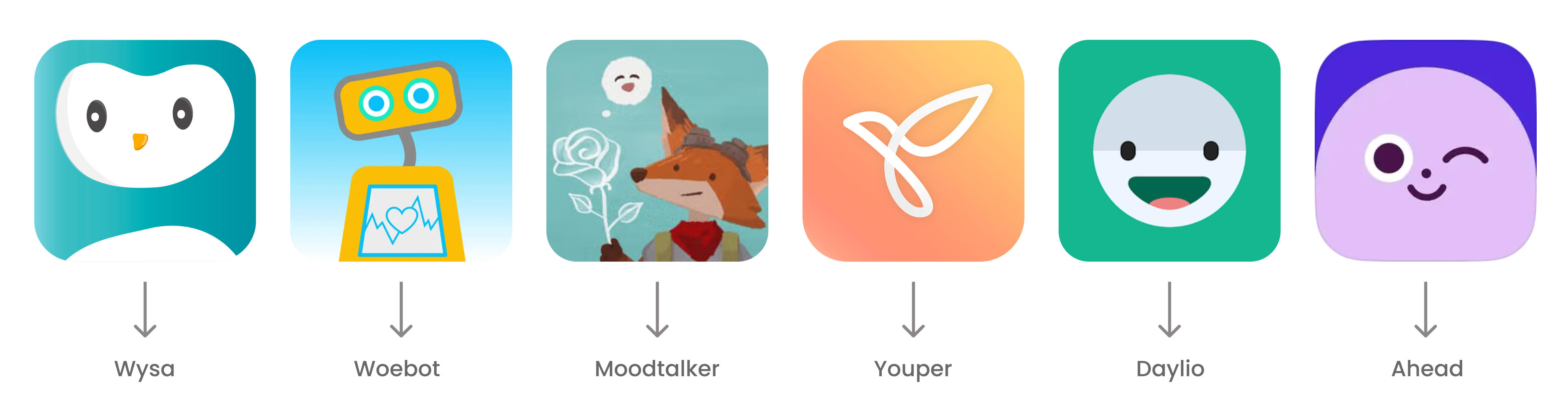
Before designing Better You, I analyzed existing mental health and wellness apps to understand how they support emotional well-being, create engagement, and encourage self-reflection.
Conversational Support
Apps reviewed: Wysa, Woebot, Youper
These apps showed how guided conversations can make emotional support feel more approachable and personalized. I learned the importance of creating supportive dialogue, using the right tone of voice, and designing conversations that encourage reflection without replacing professional care.
Mood Tracking & Self-Reflection
Apps reviewed: Daylio, Moodtalker, Youper
These experiences highlighted how simple emotional check-ins can help users recognize patterns and better understand their feelings over time. Reducing friction and making tracking feel effortless are key to building consistent habits.
Engagement & Habit Building
Apps reviewed: Ahead, Daylio
These apps demonstrated how interactive elements, daily activities, and progress feedback can encourage users to return and build healthier routines. This inspired the use of a virtual pet mascot and daily challenges in Better You to create a more engaging experience.
2. Validating the concept with expert insights
Before moving into the design phase, I wanted to validate whether a digital experience could realistically support emotional well-being. I reached out to psychotherapist Elaine Botelho, who shared valuable insights on mental health best practices, user needs, and potential risks when designing this type of experience.
Key insights from the conversation:
Digital tools can make emotional conversations easier.
Elaine highlighted that the initial sense of distance created by technology can sometimes help users feel more comfortable opening up about personal struggles.
The experience should complement, not replace, professional care.
A key consideration was ensuring the product never suggests it can replace therapy or psychiatric support.
Trust should come before sensitive conversations.
Instead of immediately asking users about difficult experiences or traumatic events, the experience should first create a sense of safety and trust before exploring deeper emotions.
Short activities can improve engagement.
Interactive elements, challenges, and simple exercises can help users stay engaged. However, activities should be quick and approachable to avoid creating frustration or disengagement.
3. Learning from potential users
After validating the concept with a mental health professional, I conducted paper surveys with 29 participants to better understand perceptions around emotional support apps, privacy, interactive features, and conversational technology.
The research was conducted in two phases:
- Initial concept validation: 5 participants reviewed the first version of the idea.
- Concept refinement: Based on their feedback, I adjusted the concept and surveyed an additional 12 participants to gather broader perspectives.

Insights
The purpose of the virtual pet needed to be clearer.
While participants found the idea engaging, some questioned how a virtual pet could genuinely support emotional well-being since traditional pet therapy relies on physical interaction. This led to redefining the pet as an emotional companion and engagement feature rather than a replacement for real-life support.
Privacy and data control were important concerns.
Participants wanted reassurance that their emotional information would remain private, could be deleted, and would not be shared without their consent.
Conversational technology needed to feel approachable.
Some participants were unfamiliar or hesitant about interacting with AI-based tools. This highlighted the importance of creating a welcoming experience with clear guidance and a supportive tone.
4. Refining the concept through feedback
Initial concept
An interactive experience designed to support teenagers experiencing loneliness or emotional isolation after difficult life events by asking them questions and giving back self-awareness reports after some time. The concept added a virtual pet for companion.
Validated with: 5 participants
Refined concept
An interactive experience designed to support Gen Z with their emotional wellness combining guided conversations with a supportive dog mascot, mood tracking and self-reflection activities to encourage engagement and emotional awareness.
Validated with: 12 participants
Key Research Insights
01
→ Complement, don’t replace professional care.
The experience should support emotional well-being through guided reflection while clearly positioning itself as a companion—not a substitute for therapy or psychiatric care.
02
→ Build trust through transparency.
Users need to feel safe sharing personal information. Privacy, data control, and clear communication are essential to creating a trustworthy experience.
03
→ Design for long-term engagement.
Features like a virtual pet, daily challenges, and lightweight interactions can encourage users to return regularly and build healthier emotional habits over time.
04
→ Keep the experience approachable.
Simple interactions, clear microcopy, and a friendly personality help reduce barriers, making emotional well-being feel less intimidating and easier to incorporate into everyday life.
Understanding the User
Defining the target audience and user needs
Initially, I planned to focus on teenagers between 12 and 15 years old, as this is a critical stage of emotional development. However, reaching this audience presented challenges, including parental consent requirements and privacy considerations for minors.
Based on these constraints, I expanded the target audience to include Gen Z and young adults looking for an accessible, casual, and supportive experience for emotional self-awareness.
During this phase, I focused on understanding users’ needs, behaviors, and expectations around emotional well-being tools. Through surveys and user research, I identified opportunities to create a more approachable and engaging experience.
To explore different user motivations and behaviors, I created three personas based on research insights, each supported by real-life scenarios. I also mapped the journey of a first-time user to identify key moments, potential barriers, and opportunities to improve the overall experience.
Research artifacts: Personas | Scenarios | Sitemap | User Journey
Early Usability Testing
Exploring flows through paper prototypes
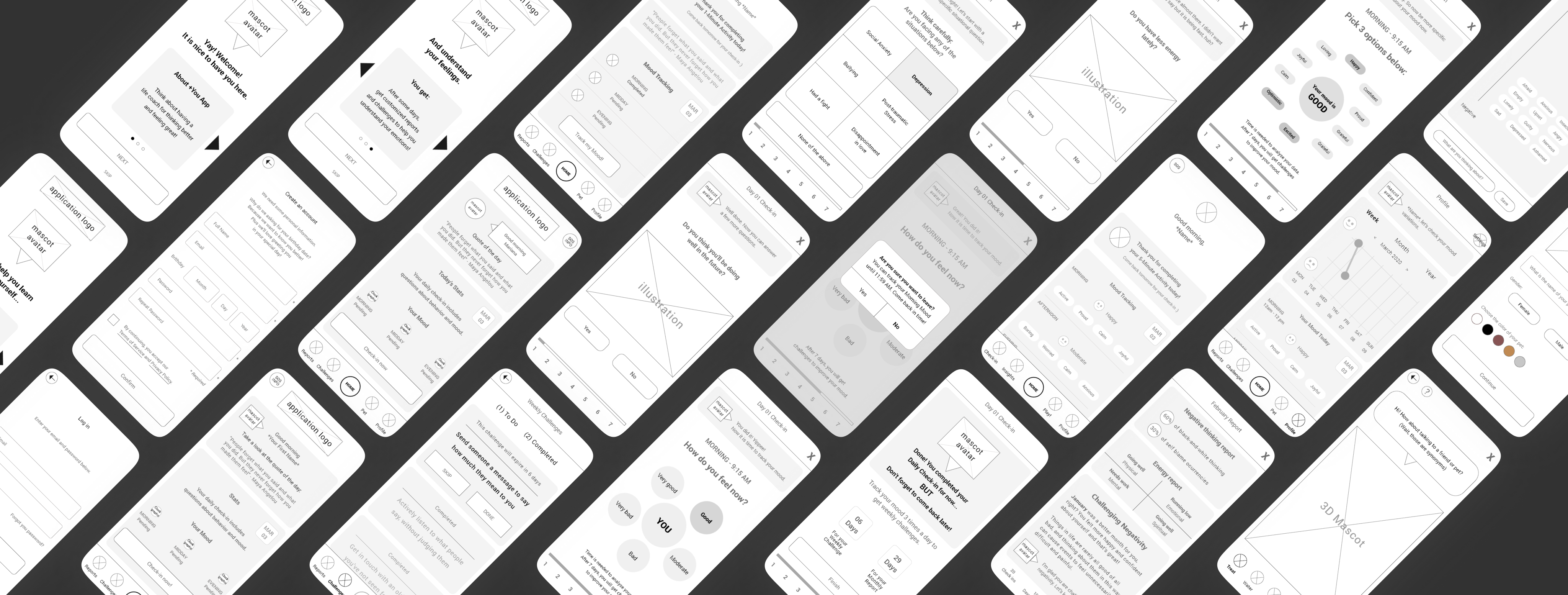
Before moving into digital design, I created a paper wireframe with 33 screens to explore the core user flows and gather early feedback.
Six participants took part in the testing process:
- Three participants freely explored the prototype and marked areas they expected to interact with.
- Three additional participants completed four tasks while thinking aloud, sharing their thoughts and questions throughout the experience.
The feedback helped identify usability issues and refine key flows, including simplifying onboarding, improving mood tracking interactions, and better integrating the virtual pet into the overall experience.

Task-based
testing results
Task #1 — First-time onboarding
Goal: Find the home screen after opening the app.
You’ve just opened the app for the first time. Can you find your way to the home screen?
- Success Rate (100%)
- 0 Error per task
- 1 Confusion per task
- Ease of Use: 5/5
Key observation:
Users were able to complete the flow successfully, but some needed more context about the app’s purpose and features.
Task #2 — Daily emotional check-in
Goal: Complete the daily check-in activity.
Now that you’re on the home screen, go ahead and complete your daily check-in activity.
- Success Rate (100%)
- 0 Errors per task
- 3 Confusion per task
- Ease of Use: 4/5
Key observation:
The flow was easy to complete, but some users needed additional guidance when choosing emotional responses.
Task #3 — Mood tracking
Goal: Log a mood entry and understand mood variations.
This time, you want to track your mood variations. How would you log your mood?
- Success Rate (93%)
- 2 Errors per task
- 5 Confusions per task
- Ease of Use: 3/5
Key observation:
Mood tracking was the most challenging flow. Users wanted more detailed options and clearer guidance when recording emotions.
Task #4 — Virtual pet interaction
Goal: Explore how to interact with the virtual pet.
Now, give the virtual pet a try. How would you interact with it?
- Success Rate (100%)
- 1 Error per task
- 2 Confusions per task
- Ease of Use: 4/5
Key observation:
The interaction was intuitive, but users needed a clearer understanding of how the pet connects to emotional well-being.
Key findings &
design improvements
01 — Clarifying the app’s purpose during onboarding
Three out of six participants were unsure about how the daily emotional check-ins, the virtual pet, and the emotional report connected together. They needed additional context to understand the overall purpose of the experience.
Simplified the onboarding flow by focusing on the app’s core value proposition, clearly explaining how daily reflections contribute to personal insights over time, and introducing the virtual pet’s role within the experience.
02 — Making emotional check-ins more intuitive
Four out of six participants hesitated during the daily emotional check-in, showing uncertainty about how to interpret and select the available emotional options.
Improved the check-in experience by adding clearer guidance and refining the emotional choices, helping users complete the activity with more confidence and less hesitation.
03 — Creating a more meaningful mood tracking experience
Three out of six participants felt the mood options were too limited and wanted more detailed ways to describe their emotional state. One participant suggested combining the mood registration steps into a smoother flow.
Expanded the mood options and explored combining mood tracking with the emotional check-in activity to create a more seamless reflection experience.
04 — Giving the virtual pet a meaningful purpose
Participants enjoyed interacting with the virtual pet, but five out of six were unsure how it contributed to the overall experience beyond entertainment. They needed a clearer connection between the pet and their emotional well-being journey.
Repositioned the virtual pet from a standalone feature into an emotional companion integrated throughout the experience, supporting engagement, reflection, and daily self-care habits.
Design & Prototyping
Refining the Experience Through Mid-Fidelity Prototypes
Based on insights from the paper prototype testing, I created digital mid-fidelity prototypes to validate the updated flows and evaluate how users interacted with the refined experience.
Key iterations included:
Simplified onboarding
Reduced unnecessary information and clarified the app’s purpose to help users understand the experience more easily.
Combined emotional check-ins and mood tracking
Merged related activities into a smoother reflection flow, reducing friction and making emotional tracking feel more natural.
Introduced daily challenges
Added short activities designed to encourage positive habits and increase long-term engagement.
Expanded pet customization and purpose
Added more customization options and repositioned the virtual pet as a guide and companion throughout the user journey.
Task-based
testing results
Task #1 — Daily emotional check-in
Goal: Complete the daily check-in activity.
You’ve just opened the app for the first time. Can you go to the homepage and complete your daily check-in activity?
- Success Rate (100%)
- 0 Error per task
- 0 Confusion per task
- Ease of Use: 5/5
Task #2 — Virtual pet interaction
Goal: Explore how to interact with the mascot.
You are on the home screen; How would you interact with the virtual pet?
- Success Rate (100%)
- 0 Errors per task
- 1 Confusion per task
- Ease of Use: 5/5
Task #3 — Testing navigation
Goal: Findability of features.
Explore around and take a look at your reports, challenges and profile. How would you do it?
- Success Rate (95%)
- 3 Errors per task
- 1 Confusions per task
- Ease of Use: 4/5
Key findings &
design improvements
Tracking mood without having a visible record or history of it felt disconnected and unclear for users.
Display mood variations on the user's profile, allowing them to see their mood variations by day, week, and month.
Customizing the pet with too many options made it feel overwhelming and disrupted the app's flow.
The virtual pet has been replaced by a dog to ensure consistency and focus on the app's core features.
Users encountered navigation difficulties, causing confusion and stopping the flow.
Add a home button to the bottom navigation bar, and include back and close buttons throughout the app when necessary.
Prototyping
Digital high fidelity prototype for a more realistic experience.
I designed a digital high-fidelity prototype that serves as the layout for the interface, showing where elements like buttons, text, and images will be placed. In a high-fidelity prototype, the wireframe is enhanced with visual details like colors, typography, and icons to resemble the final product.
The color palette adds depth and creates a cohesive brand experience and it was intended for all audiences. At the same time, the navigable prototype allows users to interact, helping to identify usability issues early and better visualize the user experience.
Key changes to the core feature
1# 5-minute activity that included selecting a situation and answering questions based on that, became an AI chatbot for instant interaction.
2# The questions are now integrated into the mood tracker, renamed as Journey.
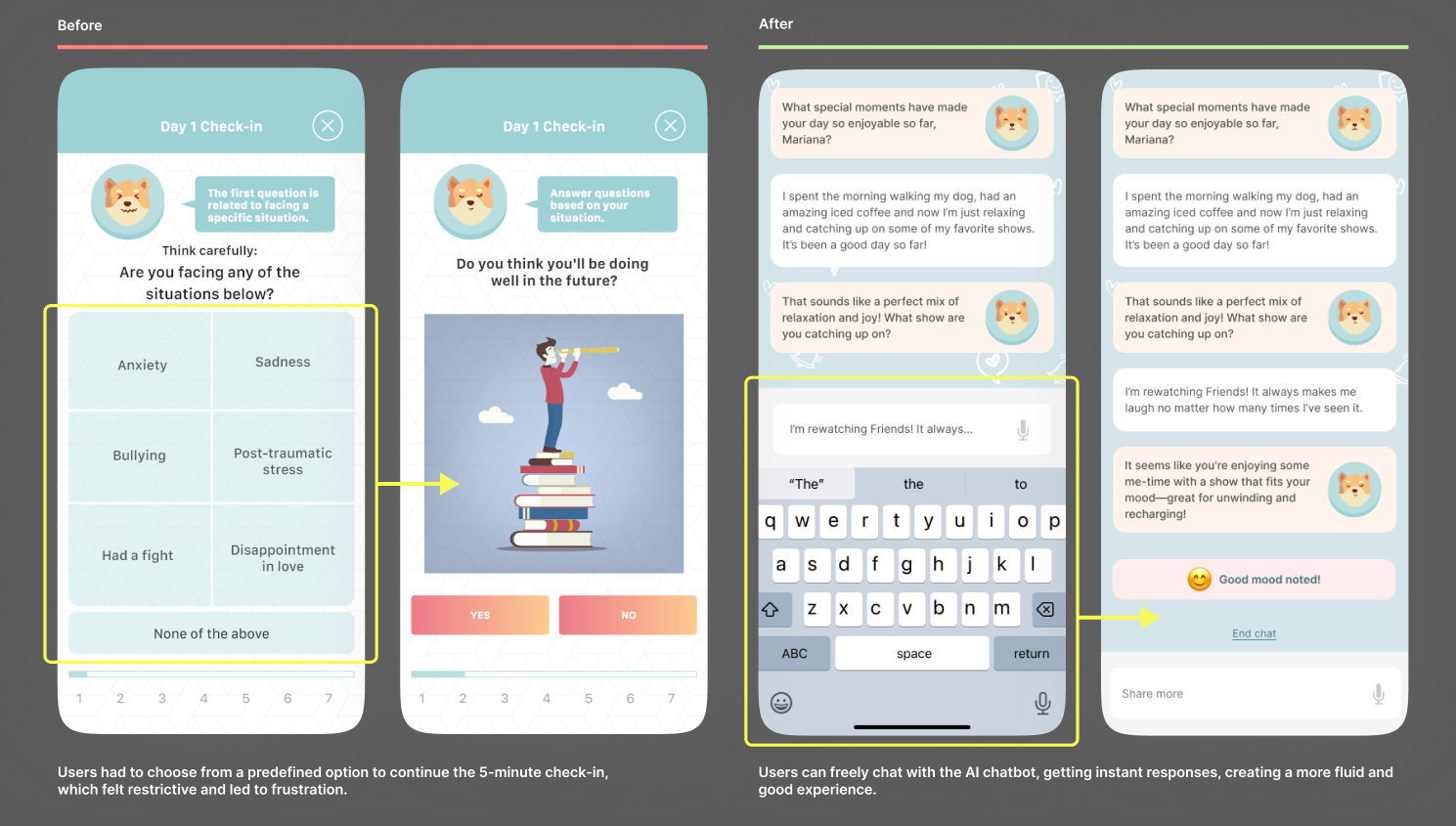
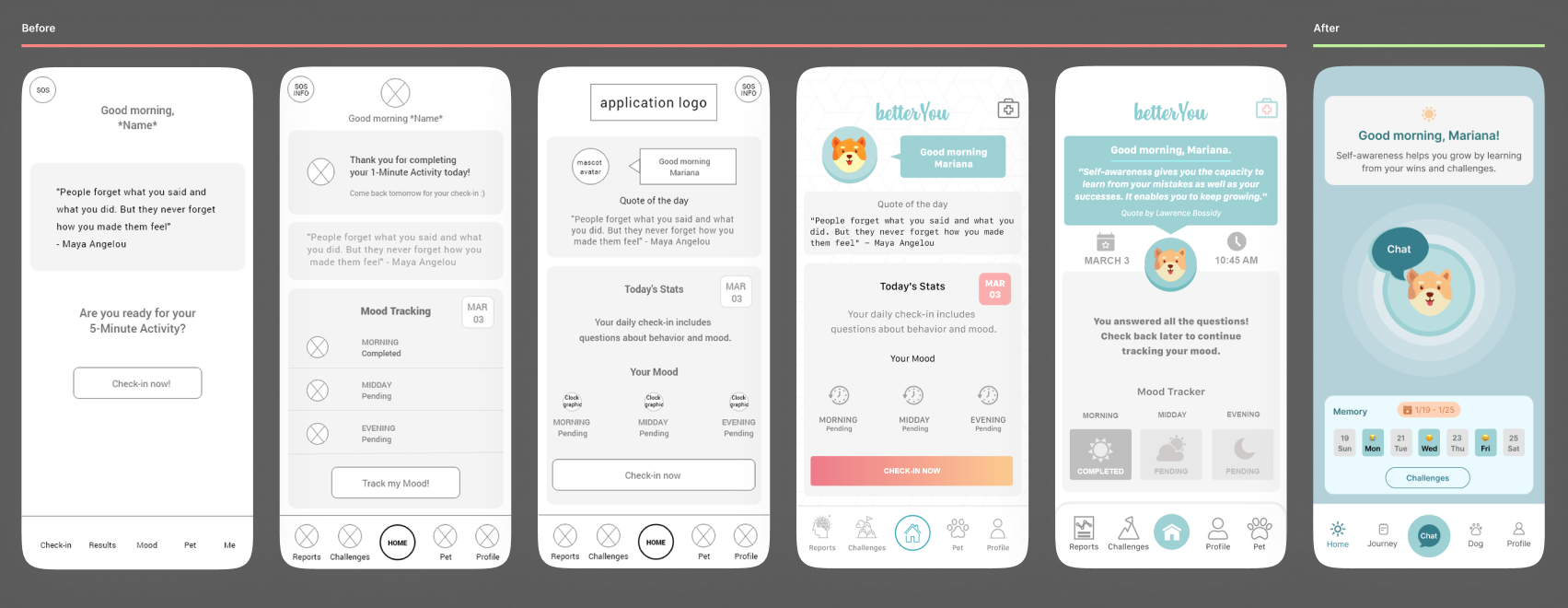
Key changes to the home
- Instead of forcing users to check in, the home page invites them to chat. An AI chatbot now handles questions and situations, offering instant support.
- Low contrast made buttons and speech bubbles hard to read, causing frustration. Boosting contrast ensured seamless readability.
- "Memory" shows the days of the current week along with mood variations. There's also a button for challenges to boost well-being, eliminating the need to track mood three times a day.
- The mascot is established as a dog, replacing the term "pet" at bottom navigation bar.
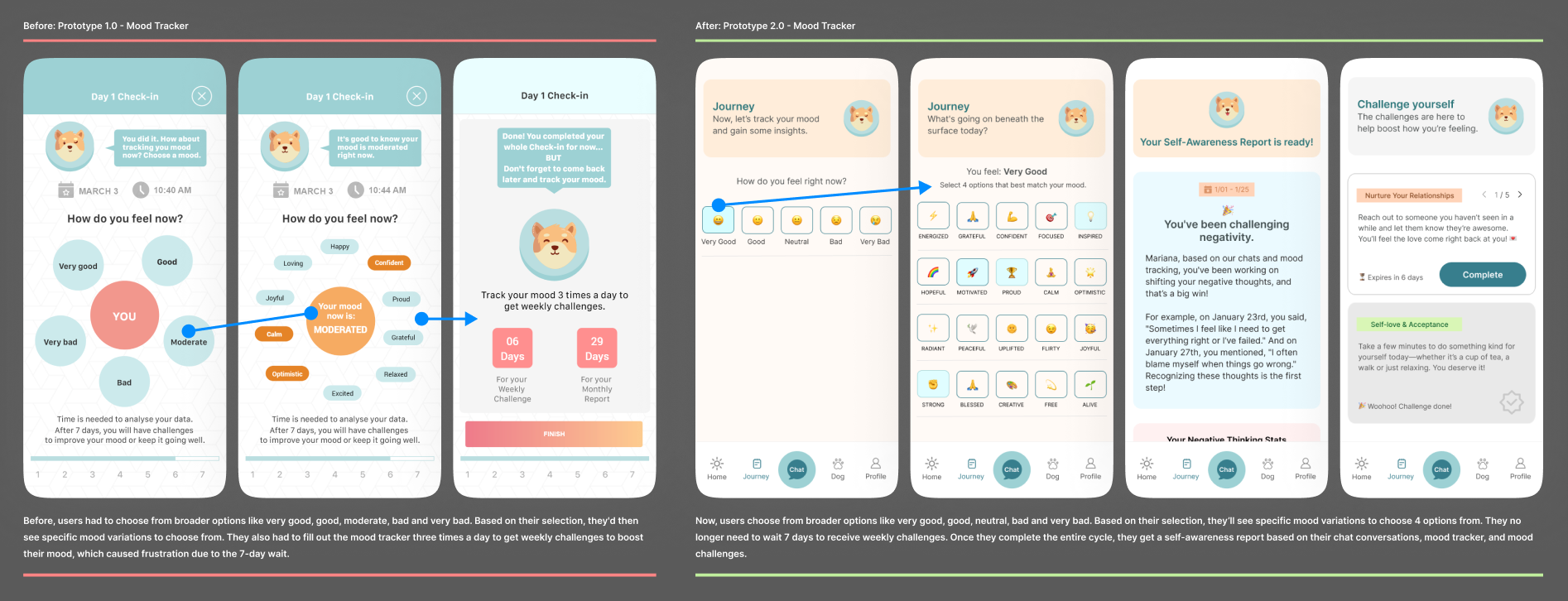
Key changes to the mood tracker
#1 Mood Tracker, now renamed to "Journey," is integrated into a seamless flow where three AI-generated questions come first.
#2 Progress indicator replaced by a dynamic question flow: when the user selects an answer, the next question appears.
#3 Bottom navigation bar remains visible at all times, giving users the freedom to exit the flow whenever they choose.
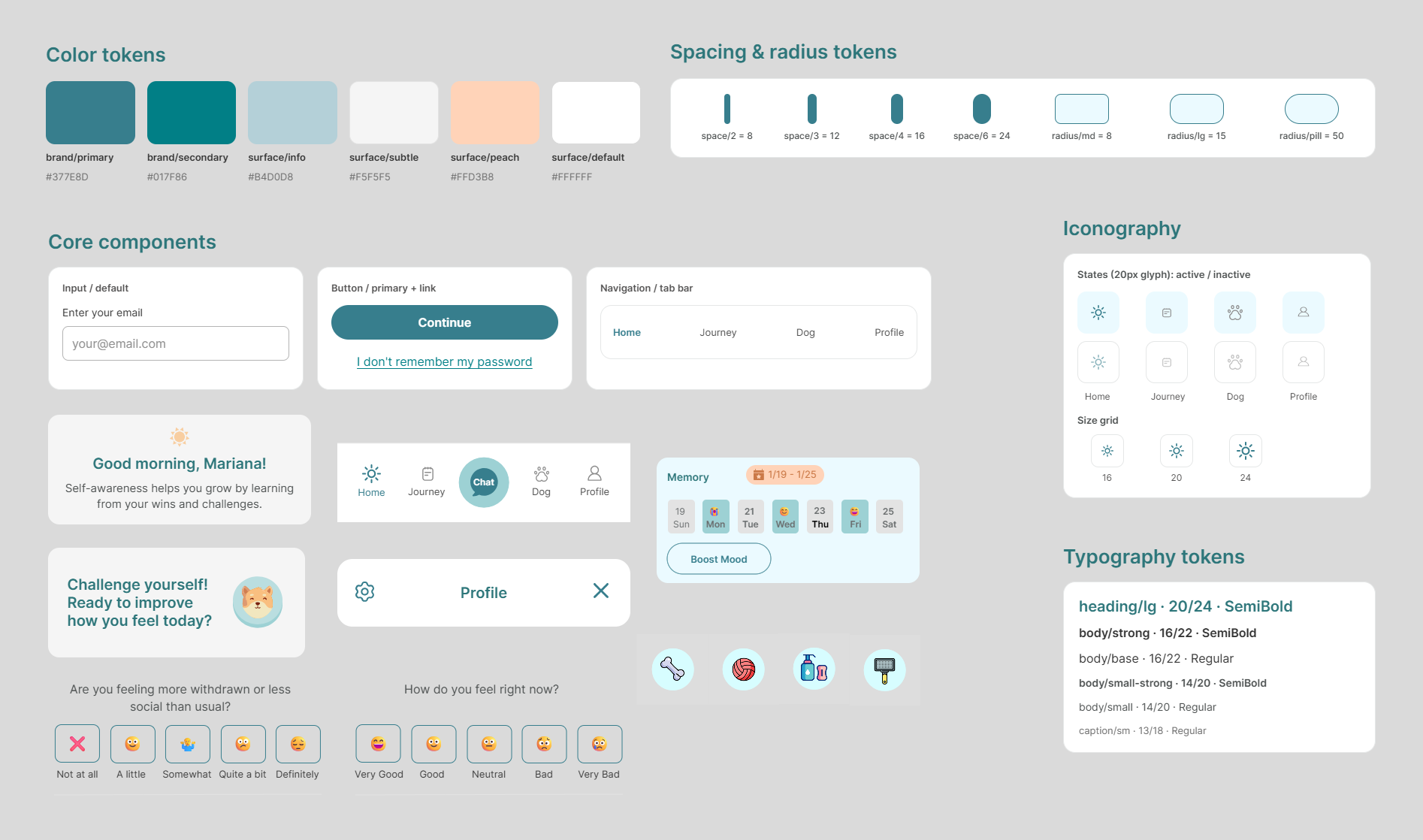
comprehensive design system
A design system built in compliance with WCAG AA accessibility guidelines.
I generated a foundational design system on Paper based on the Figma file.
app PROTOTYPE TEST
An unmoderated prototype test and UX percentile rank questionnaire helped me identify improvements and assess the refreshed prototype’s user experience.
To uncover remaining issues and trends, 21 testers participated in the unmoderated prototype test, and 7 completed the questionnaire.
I used the SUPR-Q (Standardized User Experience Percentile Rank Questionnaire), an 8-item survey developed by Jeff Sauro at MeasuringU, for efficient and insightful usability testing.
Unmoderated Prototype Test
🧩 Platform: Maze
👥 XX Testers (in progress)
📝 5 Tasks
You need to chat to share how you're feeling or talk about something on your mind. How would you do it?
🏆 100% Success rate
📉 0% Drop-off
❌ 0.1% Misclick rate
You're back on the home page. Find the section to feed the dog in (AR) augmentative reality and complete the action.
🏆 100% Success rate
📉 0% Drop-off
❌ 29.4% Misclick rate
You want to see a list of challenges that can help you boost your mood. Find the section and complete one challenge.
🏆 100% Success rate
📉 0% Drop-off
❌ 0% Misclick rate
Locate the profile section and explore the details within the settings. How would you do it?
🏆 100% Success rate
📉 0% Drop-off
❌ 0% Misclick rate
You're on the home page. Take the Journey—answer a few questions and check in with yourself. How would you do it?
🏆 40% Success rate
📉 60% Drop-off
❌ 75.5% Misclick rate
chatbot
A chatbot with pre defined answers
To have a more realistic experience, I created a chatbot with some flows.
Explore the chatbot —
This chatbot prototype highlights the main feature: providing personalized guidance based on user input.
AI chatbot
A AI chatbot
To have a more realistic experience, I created a chatbot with some flows. I gave Lovable a prompt improved by ChatGPT, and trained it to be safe, smart and useful.
User Experience Percentile Rank Questionnaire
🔍 SUPR-Q
👥 7 Survey takers
❓ 9 Questions
Is the AI chat easy to use?
- User #1: 5/5 – Strongly Agree ⭐⭐⭐⭐⭐
- User #2: 4/5 – Agree ⭐⭐⭐⭐
- User #3: 5/5 – Strongly Agree ⭐⭐⭐⭐⭐
- User #4: 5/5 – Strongly Agree ⭐⭐⭐⭐⭐
- User #5: 5/5 – Strongly Agree ⭐⭐⭐⭐⭐
Is it easy to navigate within the prototype?
- User #1: 5/5 – Strongly Agree ⭐⭐⭐⭐⭐
- User #2: 4/5 – Agree ⭐⭐⭐⭐
- User #3: 5/5 – Strongly Agree ⭐⭐⭐⭐⭐
- User #4: 5/5 – Strongly Agree ⭐⭐⭐⭐⭐
- User #5: 5/5 – Strongly Agree ⭐⭐⭐⭐⭐
Is the information on the prototype is credible?
- User #1: 5/5 – Strongly Agree ⭐⭐⭐⭐⭐
- User #2: 5/5 – Strongly Agree ⭐⭐⭐⭐⭐
- User #3: 5/5 – Strongly Agree ⭐⭐⭐⭐⭐
- User #4: 4/5 – Agree ⭐⭐⭐⭐
- User #5: 5/5 – Strongly Agree ⭐⭐⭐⭐⭐
Is the information on the prototype is trustworthy?
- User #1: 5/5 – Strongly Agree ⭐⭐⭐⭐⭐
- User #2: 4/5 – Agree ⭐⭐⭐⭐
- User #3: 5/5 – Strongly Agree ⭐⭐⭐⭐⭐
- User #4: 5/5 – Strongly Agree ⭐⭐⭐⭐⭐
- User #5: 5/5 – Strongly Agree ⭐⭐⭐⭐⭐
Do you find the prototype to be attractive?
- User #1: 5/5 – Strongly Agree ⭐⭐⭐⭐⭐
- User #2: 5/5 – Strongly Agree ⭐⭐⭐⭐⭐
- User #3: 5/5 – Strongly Agree ⭐⭐⭐⭐⭐
- User #4: 5/5 – Strongly Agree ⭐⭐⭐⭐⭐
- User #5: 5/5 – Strongly Agree ⭐⭐⭐⭐⭐
Does the prototype have a clean and simple presentation?
- User #1: 5/5 – Strongly Agree ⭐⭐⭐⭐⭐
- User #2: 5/5 – Strongly Agree ⭐⭐⭐⭐⭐
- User #3: 5/5 – Strongly Agree ⭐⭐⭐⭐⭐
- User #4: 4/5 – Agree ⭐⭐⭐⭐
- User #5: 4/5 – Agree ⭐⭐⭐⭐
How likely are you to want to experience this prototype again in the future?
- User #1: 5/5 – Strongly Agree ⭐⭐⭐⭐⭐
- User #2: 5/5 – Strongly Agree ⭐⭐⭐⭐⭐
- User #3: 5/5 – Strongly Agree ⭐⭐⭐⭐⭐
- User #4: 5/5 – Strongly Agree ⭐⭐⭐⭐⭐
- User #5: 5/5 – Strongly Agree ⭐⭐⭐⭐⭐
How likely are you to recommend this experience to a friend or colleague?
- User #1: 10/10 – Extremely likely
- User #2: 5/10 – Neutral
- User #3: 10/10 – Extremely likely
- User #4: 10/10 – Extremely likely
- User #5: 10/10 – Extremely likely
Were the features and information easily accessible to you?
- 10/10 (Extremely Accessible): 10 out of 21 participants (48%)
- 9/10 (Very Accessible): 6 out of 21 participants (29%)
- 8/10 (Moderately Accessible): 4 out of 21 participants (19%)
- 7/10 (Slightly Accessible): 1 out of 21 participants (4%)
Results
A streamlined experience that can potentially improve self awareness.
Based on the good results of tests and research, the innovative experience can potentially provide resources for young people facing mental and emotional health challenges. The goal of building a data-driven, user-friendly, and engaging platform that encourages regular use and promotes self-awareness is achieved.
Many individuals don’t receive the consistent support they need for their wellness. For those in therapy, challenges such as cost, availability, and long-term commitment can create obstacles. For those not in therapy, stigma, shame, and a lack of awareness often prevent access to support.
For long-term well-being, AI can tailor recommendations and support based on user data. The hypothesis is that this non-traditional approach could provide affordable, accessible, and secure support through highly personalized features, offering effective help for mental and emotional health.
🙂
“This dog makes me happy.”
– O. R., 18 years old
Overall Satisfaction:
5/5 – Very Satisfied
🙂
“It’s like talking to a good friend.“
– T. S., 22 years old
Helpfulness of features:
5/5 – Very Satisfied
🙂
“The task was easy to do.“
– G. B., 27 years old
Ease of use:
5/5 – Very Easy
🙂
“The app is beautiful and cute!“
– P. S., 22 years old
Visual appeal:
5/5 – Extremely appealing
What I learned from this project
01
→ Understanding user behaviour
Usability testing helped me understand how users interacted with the AI wellness partner and identify challenges, guiding decisions to create a more intuitive conversation flow.
02
→ The power of iteration
This project reinforced the value of testing and refining. Feedback helped improve key features, including the chatbot, mood tracker, and pet interaction experience.
03
→ Connecting product vision and business goals
I learned that building a product involves more than UX decisions. Considering scope, budget, timelines, and priorities helped me understand the challenges of turning an idea into reality.
04
→ Designing meaningful AI interactions
Creating an AI wellness partner showed me that great AI experiences require more than technology. Thoughtful conversations, clear guidance, and a human-centered approach help build trust and value.
05
→ Building inclusive experiences
Accessibility goes beyond guidelines. Small improvements in colour contrast, typography, and testing can make products more welcoming and easier to use for everyone.
As a product designer, I worked end-to-end first research and usability testing, which led to improved satisfaction with the experience.
The END/FIM
Updates to improve accessibility
- Having more time, I would love to conduct more remote or in-person budget-friendly usability tests to refine the prototype. The tests could be the following:
- In-person/virtual interviews with parents of teens regarding their willingness to pay for the app’s premium features.
- Usability Test with a small sample of users using the high-fidelity prototype. Quick tests of Usability Hub: Five Second Test, Click Test, Question Test, Navflow & Preference test.
- User Testing platform: Record the prototype screen, the physical user’s video as he interacts with the app, and audio to record the user’s thoughts/feelings (thinking out loud).
- Testing emotional engagement: Micro-surveys with two to three questions like “Do users feel comfortable answering the following questions?”
Talking Business
- Revenue
Taking businesss in consideration is important to X designers understand the impact for the business. I explored some ideas to make this app generate a profit as a freemium, extra features like getting reports faster, receive more mood challenges and more pet customizations. Premium plans could start at CAD$4.99 (+tax) per month or CAD$44.99 (+tax) annual fee. - Trinity Strategy
It is based on behaviour, result and experience. People use the app because of the need for emotional support combined with self-awareness through cognitive therapy.
People want to have a meaningful experience that makes a positive impact. The app meets their needs by providing a safe and friendly environment. - Interaction provides an exchange: users provide data to obtain relevant information about themselves after some time. The desired result is to create a premium user base sufficient to cover maintenance and improvement expenses, in addition to generating profit. And that the information obtained by users can help improve their mental/emotional health situation.