
PROJECT
Better You
Mobile Design | UI/UX Design
PROJECT
How can an interactive platform help a teenager get to know himself better?
Skills
Product Design
User Research
iOS UI Design
Tools
Adobe XD
Adobe Illustrator
InVision
Team
Me – UI/UX Designer
Psychologist (Consultant)
Overview
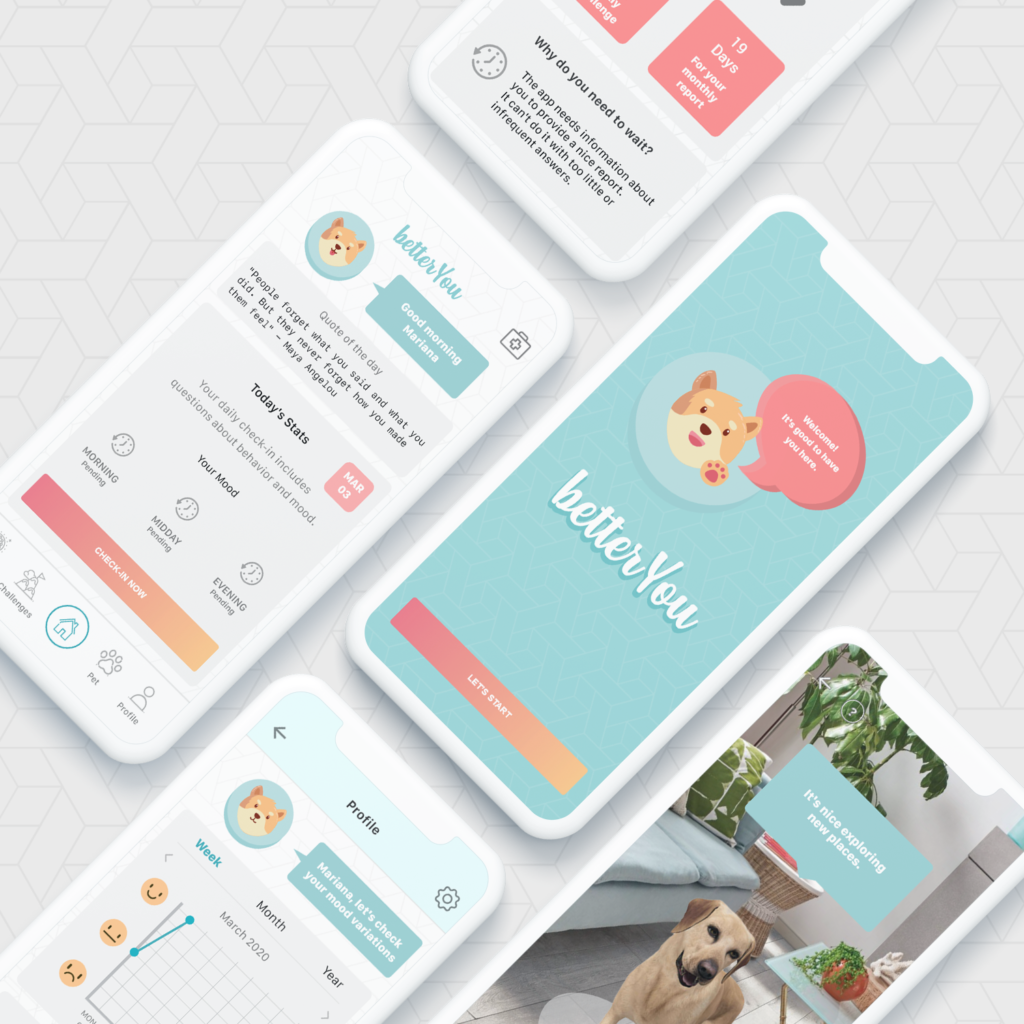
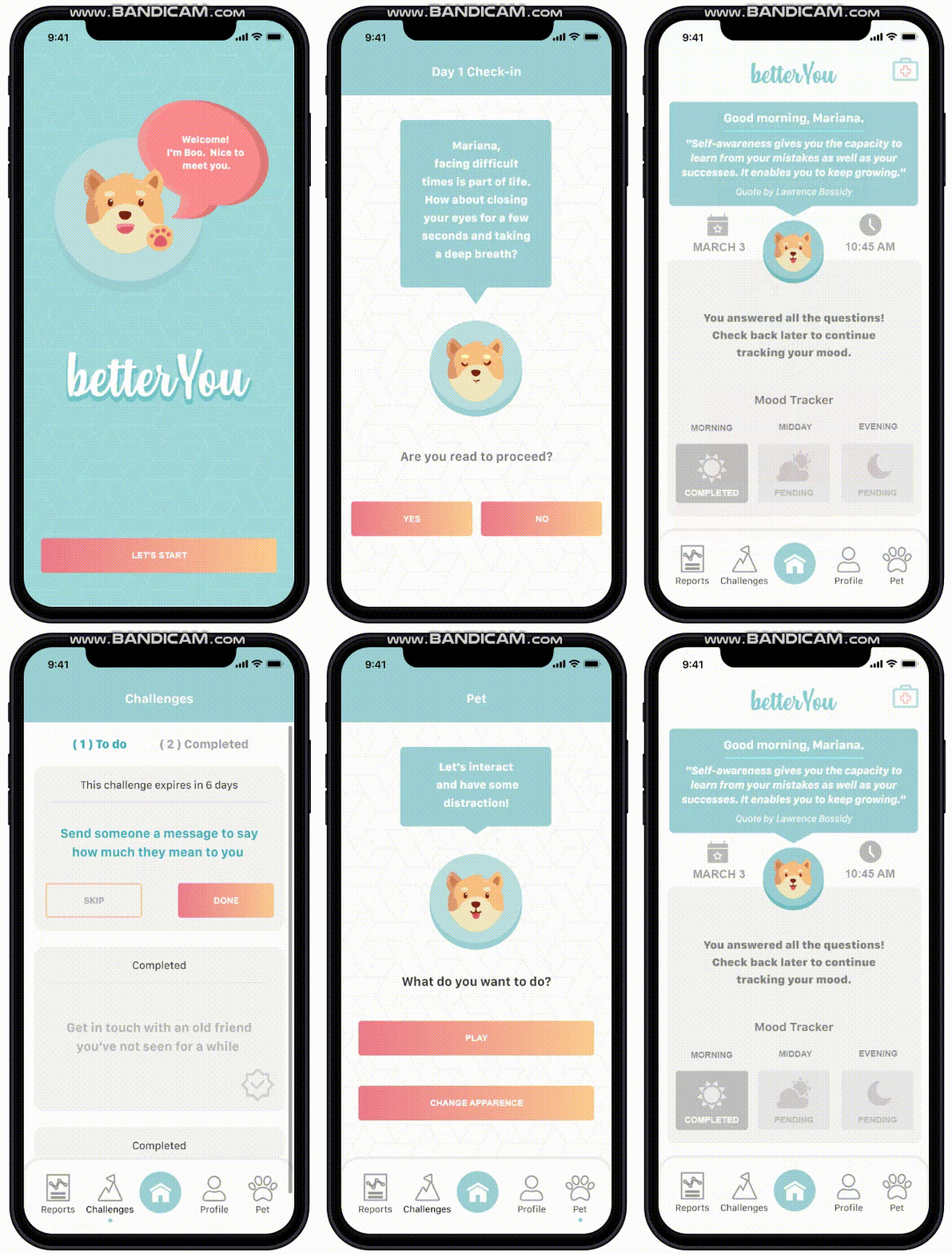
The BetterYou project proposes an Artificial Intelligence (AI) iOS mobile app that “learns” from users’ responses to generate reports. Teenagers can track their moods, receive challenges and interact with a 3D dog in Augmented Reality (AR) technology.
Counselling apps are popping up around the world and are promising. By using the already known and consecrated Cognitive Behavioral Therapy (CBT), these apps can help users with short-term treatment, becoming even more effective when combined with traditional psychotherapy or counselling.
At any time of the day, users can use the app to answer AI-generated questions. After some time collecting data, the AI is able to provide them with reports based on how they are reacting to events that are happening to them, mood variations and more.
User Research for concept validation
I surveyed 15 people to validate the first concept of the platform and all participants had emotional or mental health problems during adolescence.
Insights
Affordability and stigma are some of the important barriers preventing people from seeking out the help they need.
A virtual pet is interesting, but how it can really help someone facing sensitive situations?
What methodology is the best for virtual therapy? And another concern is Concern data privacy.
Content validation
I conducted an interview with Elaine Botelho, a Brazilian psychologist that volunteered to help me validate content. Below are some of the questions and answers:
Q: Can a mobile app cooperate to improve a person’s emotional health? Why?
A: I believe so. I understand that it is difficult to exhaust the reasons, but I mention the difficulty of some people in “opening up” to others talking about their pain. Initial impersonality, oddly enough, can be a facilitator for this process.
Q: What triggers should the app not have?
A: I cite as the main one to be avoided that of proposing to replace the reasoned therapies.
Q: Do you think the application should ask users to specify the bad/difficult situation they are going through? If so, what situations?
A: I think that this request should not be formulated directly, I say this because it is usually not easy for teenagers to deal with painful situations. There is a need to build a relationship of trust so that such matters are addressed and treated. My biggest concern is, touching on these issues, fomenting emotional pain and leaving it open, without proper treatment or direction.
Q: It is important to engage users to use the app at least once a day. Do you think 5-minute questions or activities are appropriate? Why?
A: Yes, I think it’s super appropriate. I think that the proposals for activities really shouldn’t be too long, since adolescence tends to be marked by impatience and anxiety, so something that demands a lot of time can bore them and lead to withdrawal. I also think that activities can include rewards, challenges … proposals that instigate and stimulate adolescence.
View the complete interview by clicking here.
Definition
First concept:
The main goal of the project is to provide a safe environment for teenagers to get to know themselves better. The product could be a smartphone app featuring a virtual pet for companionship.
Updated concept after concept validation:
The goal of the project is to provide a safe environment for teenagers to share their data, aiming to know themselves better after some time. The product could be a counselling app that uses artificial intelligence to generate reports based on users’ answers to sensitive questions. A dog would be the app’s mascot. Its mission would be to interact with, lighten the matter and entertain teens.
Market Research
I looked into five counselling platforms during a comparative analysis. Some were mentioned during user research. Understanding how these platforms offer virtual therapy and generate reports helped me to identify common feature patterns.





Findings and Opportunities:
- Friendly mascots are commonly present in counselling apps.
- Counselling platforms depend on constant use.
- Propose users take action.
- Some entertainment helps to increase retention.
- Data security is crucial. Protecting and giving people control over their data too.
- Psychological terms need to make sense.
- How to think outside of the box? How do explore opportunities counselling platforms are missing?
Problem
How can an interactive platform help teens to understand their feelings and identify behaviour patterns?
Ideation
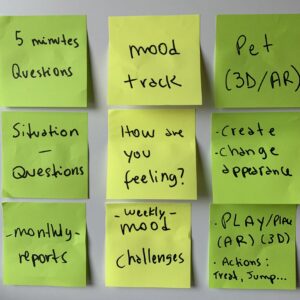
I recruited two participants for my in-person brainstorming session. We decided to add more than one feature — 5-minute questions, a mood tracker, interactive pet.
Solution
I proposed BetterYou: An innovative iOS mobile app that combines emerging technologies to gather teens’ responses to generate customized reports.
AI counselling apps are emerging around the world. These apps can use Cognitive Behavioral Therapy (CBT) to formulate questions and they are considered a short-term treatment that focuses on the way people react to things that happen to them.
A study published in the World Psychiatry journal in 2014 compared people who received CBT treatment online with those who received it personally. The result showed that both forms were equally effective.
Low-Fidelity Explorations
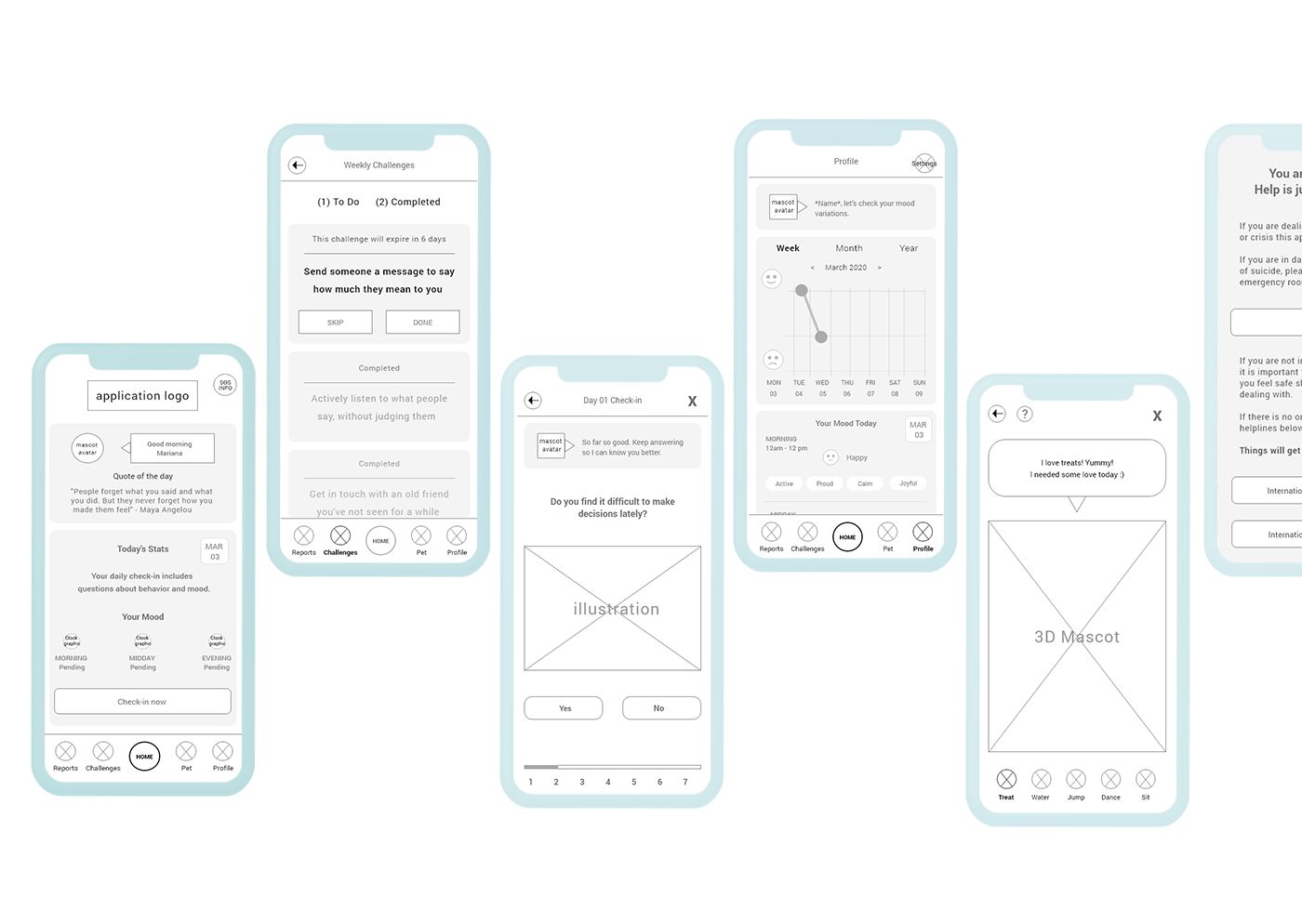
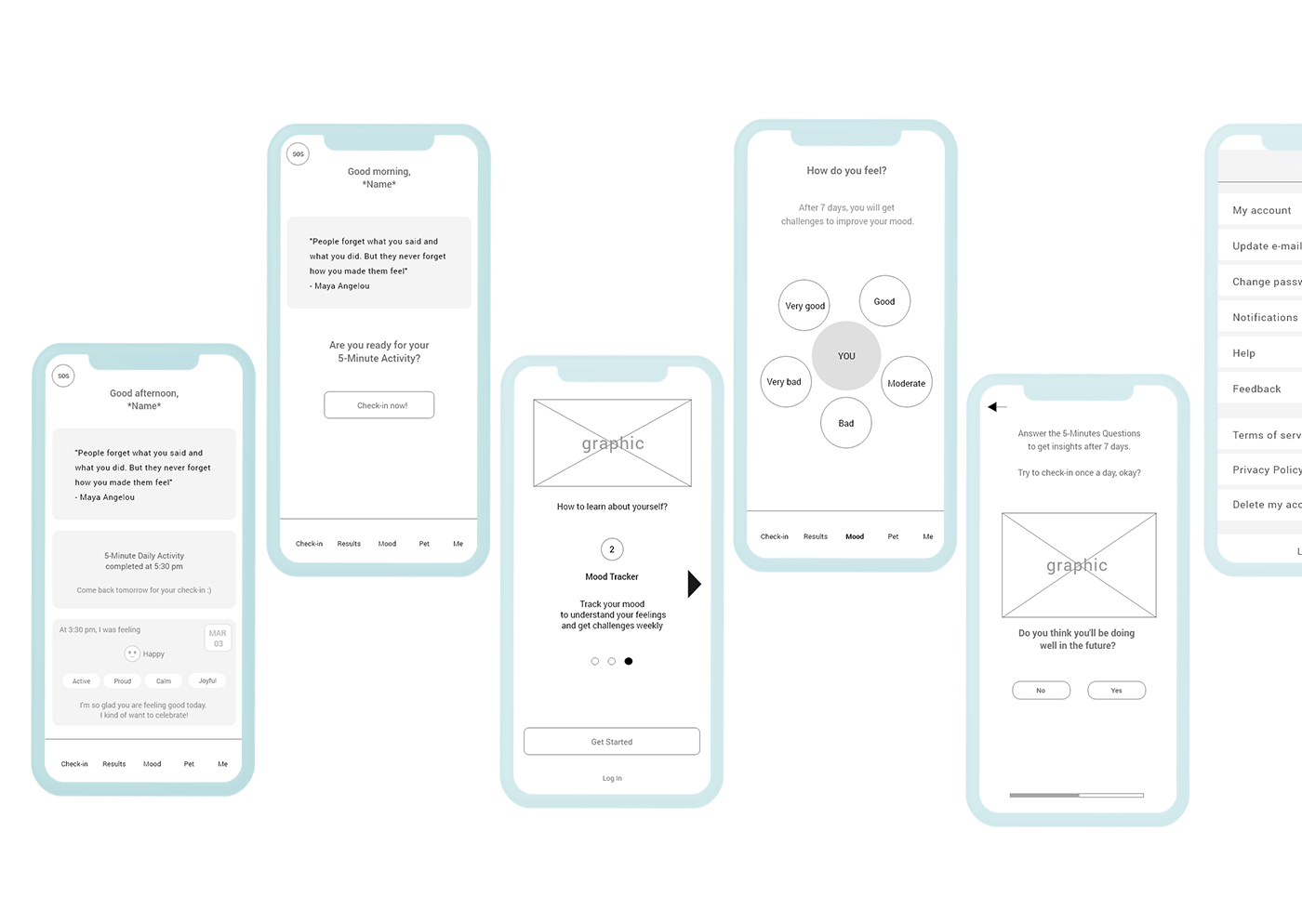
I built a low-fidelity wireframe of 33 screens using Adobe XD. This wireframe was tweaked three times after being tested by volunteers.

Main User Flows:
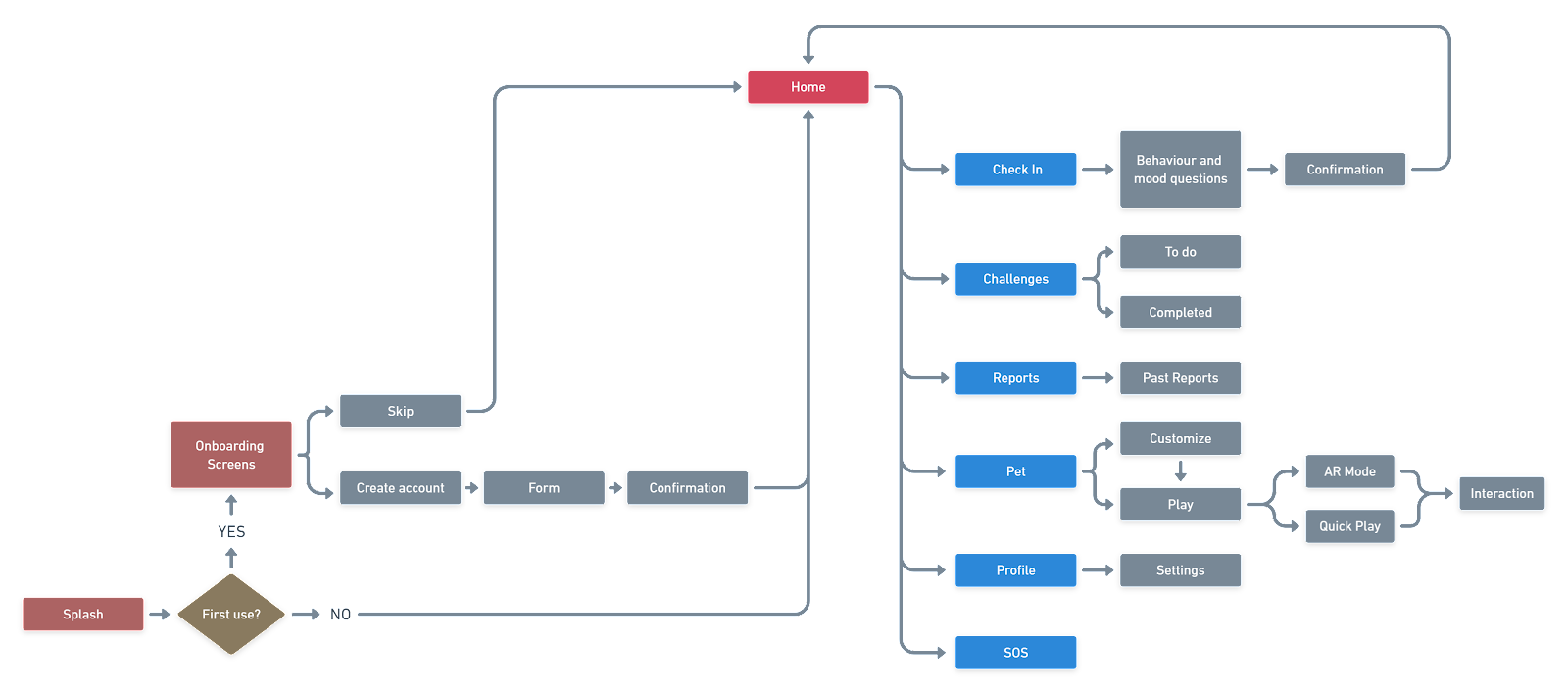
Daily check-in: Tap the “Check in” CTA button on the home screen > Choose from anxiety, sadness, bullying, post-traumatic stress, lighting, disappointment in love or none > Answer 4 related questions> Confirmation screen, tap next > Home screen.
Record mood: Tap “Mood” in the navigation bar > Select one option: morning, midday or evening/night > Choose the intensity of your mood (very good, good, moderate, bad and very bad), tap next > Confirmation screen.
Create a virtual pet: Tap “Pet” in the navigation bar > Create new pet > Pick a name, chose between dog or cat > choose pet color and tap next > Interact with your pet by giving it virtual treats, playing with a virtual ball, and training it to sit or jump.
Medium Fidelity Flow Explorations
The core function and mood tracker became one because most users felt confused.
Based on the suggestion of Elaine, the physiologist, I created the Challenges. This way, one can take action and improve mood.
And for the AR pet, people asked me to add different animals. However, doing that would generate constraints regarding requirements. All screens of the app would need to reflex the change. So, the AR pet became just a dog named Boo that can be stylized with fun accessories.
Interact with the prototype here.
Testing & Iterations
Usability Testing
A total of 6 users went through the prototype’s low-fi and mid-fi versions to run through the tasks. I went ahead with the screen version which led to a higher task completion rate.
Proposed tasks
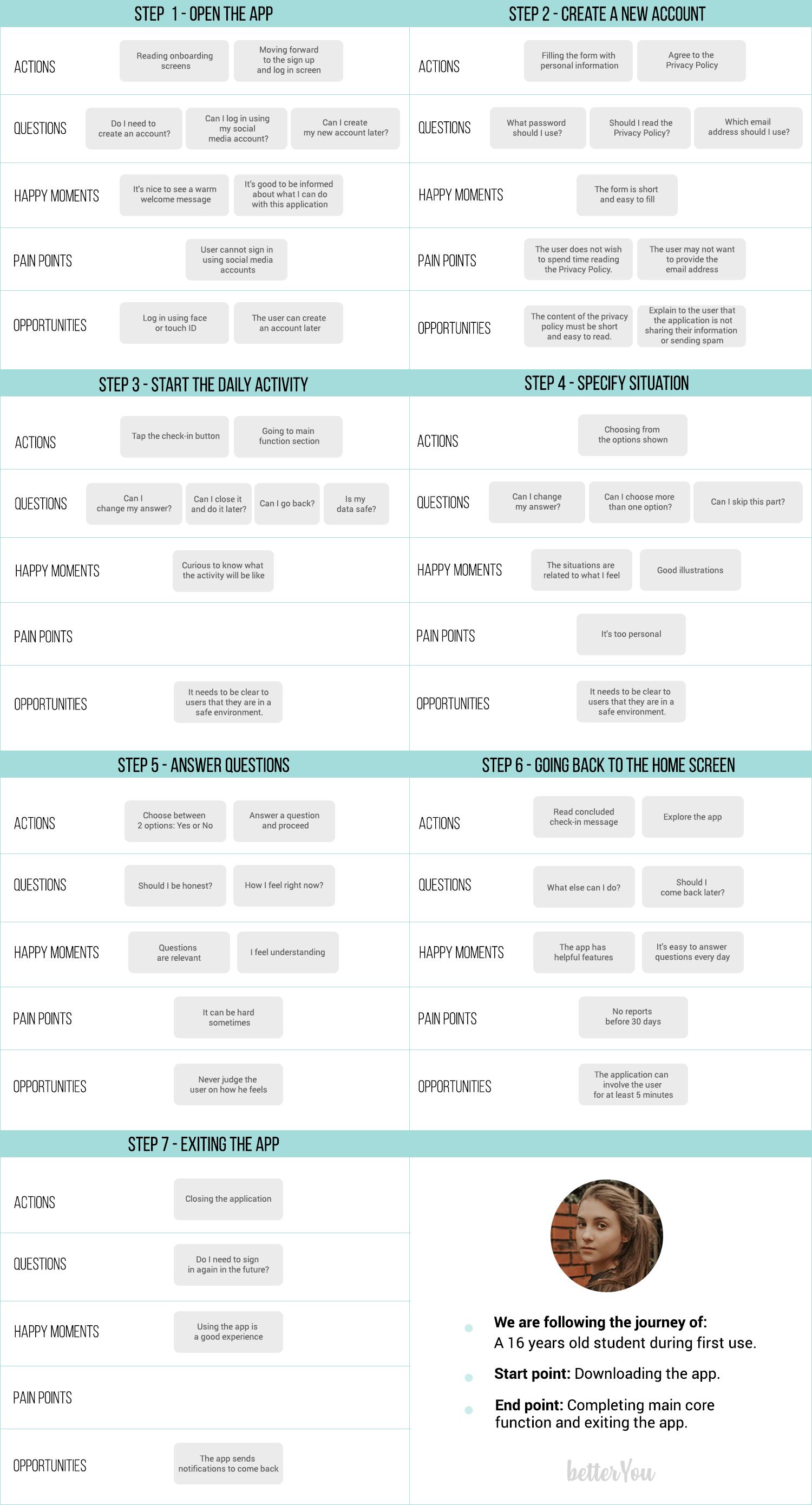
1 Complete daily check-in
User Flow: Navigate to the home screen > Tap the “Check in” CTA button > Choose from anxiety, sadness, bullying, post-traumatic stress, lighting, disappointment in love or none > Answer 4 related questions > Confirmation screen.
2 Record your morning mood
User Flow: Tap “Mood” in the navigation bar > Select one option: morning, midday or evening/night > Choose the intensity of mood (very good, good, moderate, bad and very bad) > Confirmation screen.
3 Create a virtual pet
User Flow: The interaction with Boo (mascot) happens when a user taps “Pet” in the navigation bar > Chose from AR Mode or Quick Play > Interact with the dog by giving virtual treats, playing with a virtual ball, and asking him to sit or jump.
Tweaks
After user testing, I recognized a theme: The pet needed to be more relevant and I added it to almost all screens. The content was also reviewed to be less explicit. Technical terms needed to be explained. To avoid triggers, the copy was reviewed by a volunteer psychologist.
I explored a different form of making the mascot more relevant. I also tweaked the content, and a volunteer psychologist proofread it.
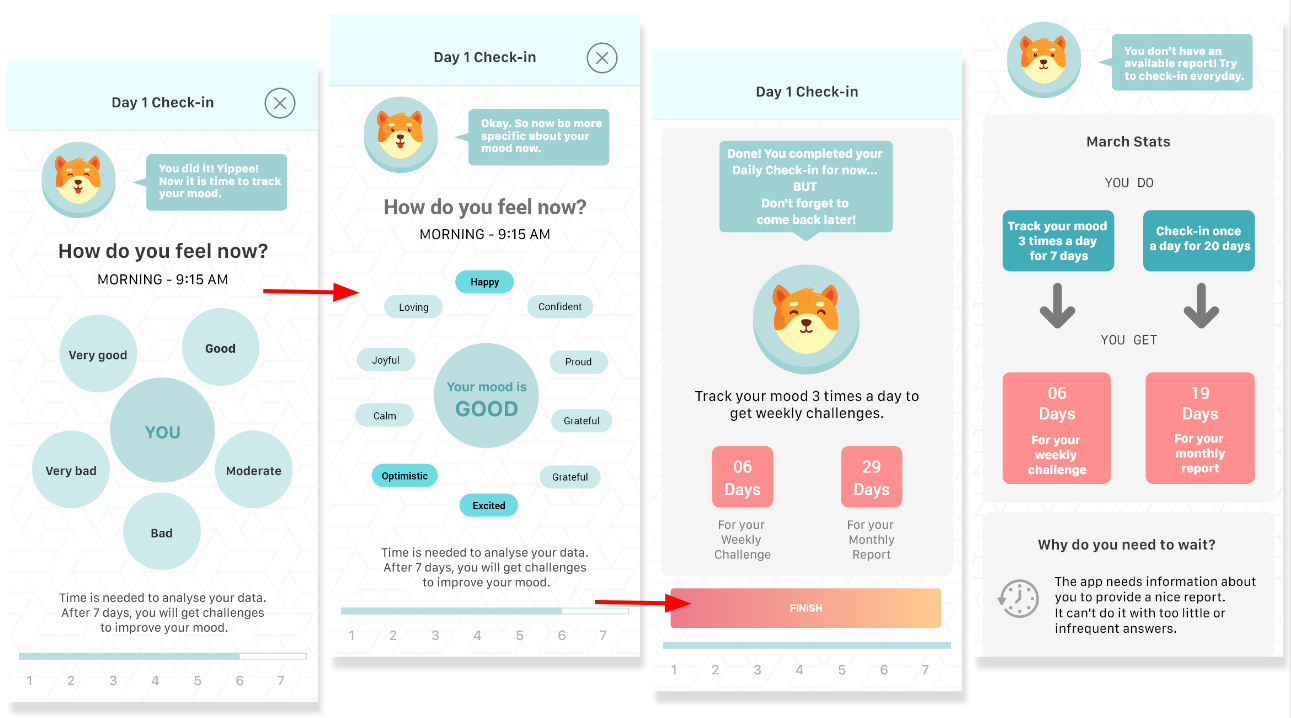
"Daily Check-in" including a pop up window
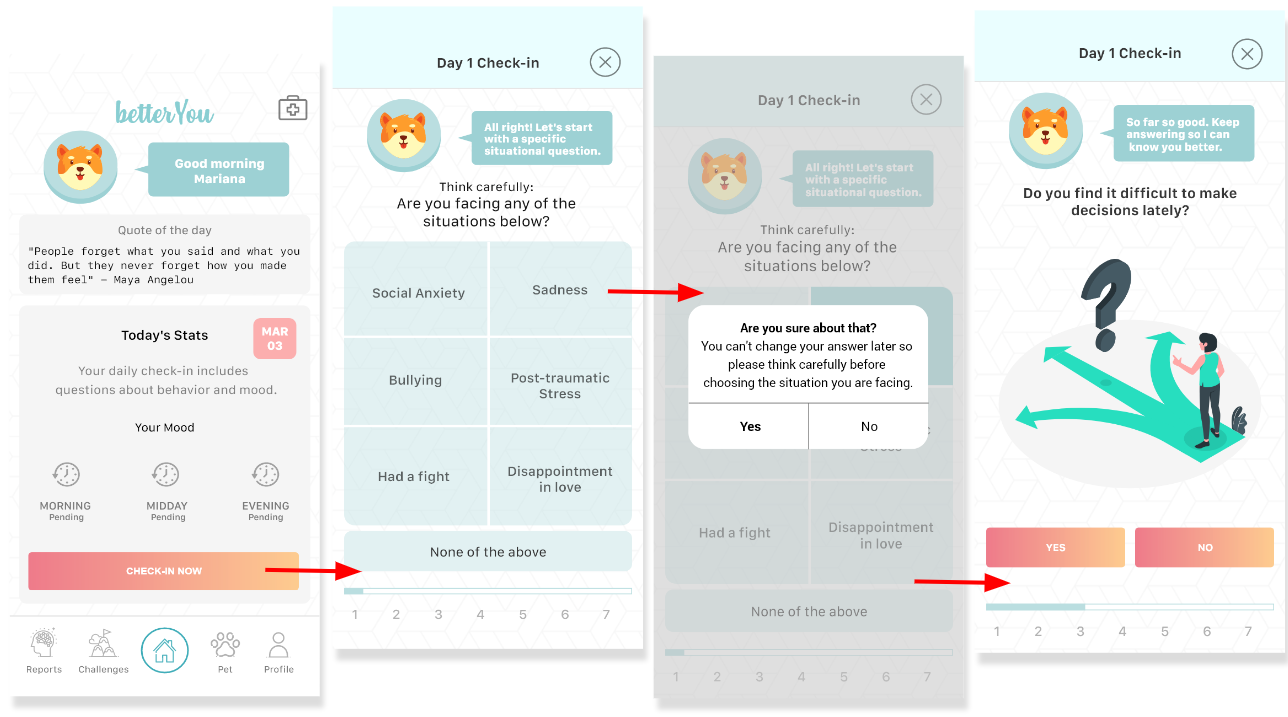
Mood Tracker including confirmation screen and monthly stats
High Fi Prototype
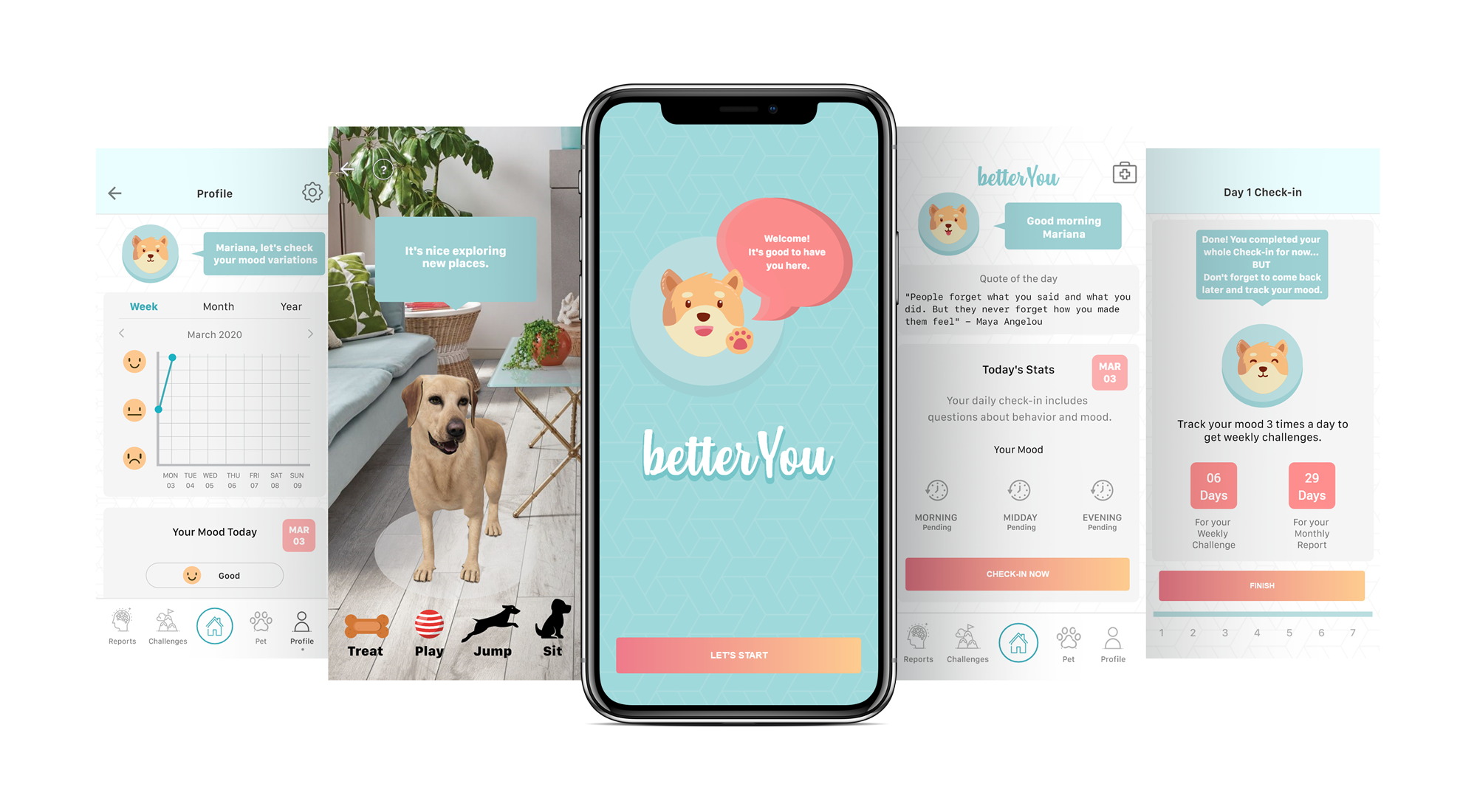
Interact with the prototype here.
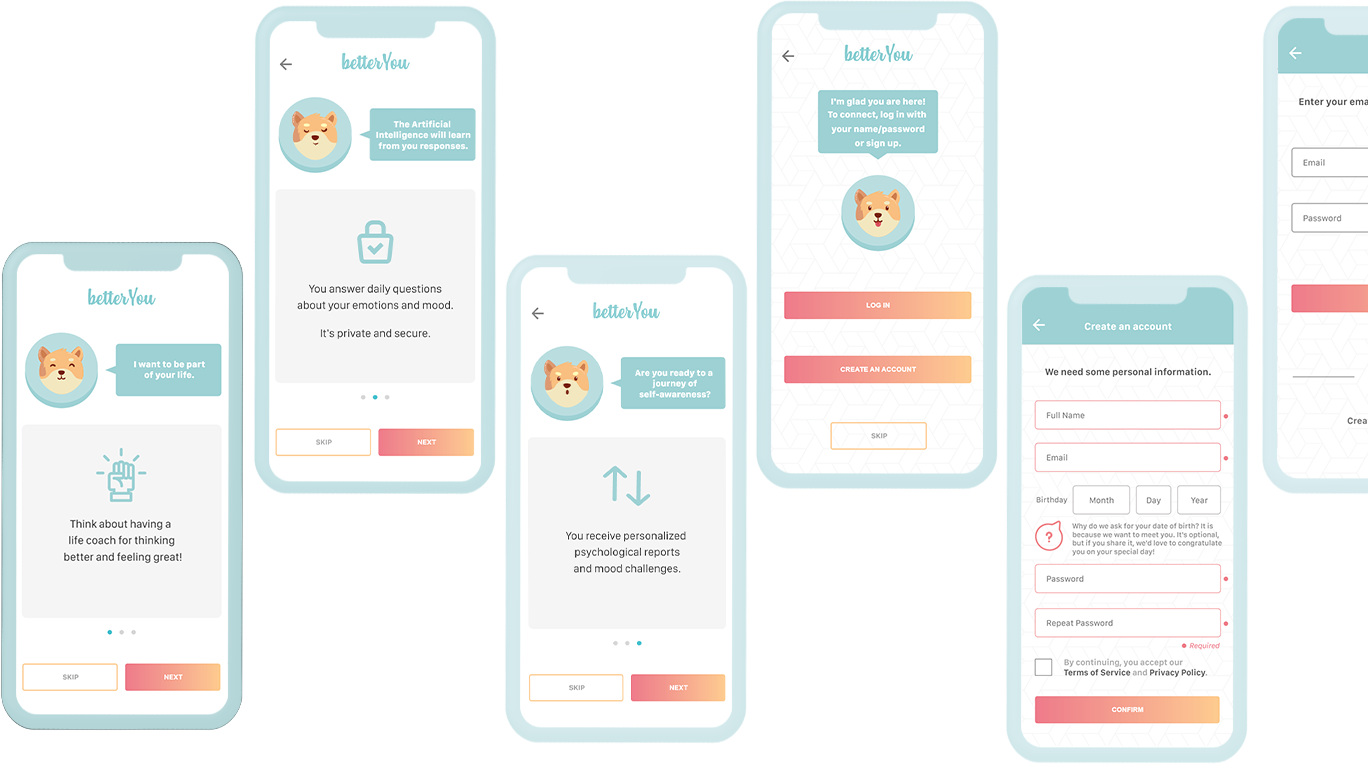
iOS User Interface Elements
- San Francisco family font for a more realistic and accessible user experience.
- Apple Design for typography, components and icons.
- iOS UI Design Kit for a simple and intuitive user interface.
Metrics
Revenue
I explored some ideas to make this app generate a profit. It would generate revenue when users sign up for a premium account. Paying to use the app gives them more reports, more mood challenges and more pet customizations. Premium plans start at CAD$4.99 (+tax) per month or CAD$44.99 (+tax) annual fee.
Trinity Strategy
It is based on behaviour, result and experience. People use the app because of the need for emotional support combined with self-awareness through cognitive therapy.
They want to have a meaningful experience that makes a positive impact. The app meets their needs by providing a safe and friendly environment.
Interaction provides an exchange: users provide data to obtain relevant information about themselves after some time. The desired result is to create a premium user base sufficient to cover maintenance and improvement expenses, in addition to generating profit. And that the information obtained by users can help improve their mental/emotional health situation.
Takeaways
Having more time, I would love to conduct more remote or in-person budget-friendly usability tests to refine the prototype. The tests could be the following:
– In-person/virtual interviews with parents of teens regarding their willingness to pay for the app’s premium features.
– Usability Test with a small sample of users using the high-fidelity prototype. Quick tests of Usability Hub: Five Second Test, Click Test, Question Test, Navflow & Preference test.
– User Testing platform: Record the prototype screen, the physical user’s video as he interacts with the app, and audio to record the user’s thoughts/feelings (thinking out loud).
– Testing emotional engagement: Micro-surveys with two to three questions like “Do users feel comfortable answering the following questions?”
What I’ve Learned
I learned more about Apple Design Resources for iOS and iPadOS. I used design templates as a foundation to build my project’s design style guide. It helped me to keep elements consistent.
I also figured out that a real app with two emerging technologies (Augmentative Reality and Artificial Intelligence) is probably too costly. In addition, this app might take up lots of storage and requires a long loading time.
Overall, I would probably make it simpler by removing extra features and focusing on fewer user flows.
The digital prototype has 52 screens. Enjoy!
PROJECT
How can an interactive platform help a teenager get to know himself better?
Skills
Product Design
User Research
iOS UI Design
Tools
Adobe XD
Adobe Illustrator
InVision
Team
Me – UI/UX Designer
Psychologist (Consultant)
The BetterYou project proposes an Artificial Intelligence (AI) iOS mobile app that “learns” from users’ responses to generate reports. Teenagers can track their moods, receive challenges and interact with a 3D dog in Augmented Reality (AR) technology.
Counselling apps are popping up around the world and are promising. By using the already known and consecrated Cognitive Behavioral Therapy (CBT), these apps can help users with short-term treatment, becoming even more effective when combined with traditional psychotherapy or counselling.
At any time of the day, users can use the app to answer AI-generated questions. After some time collecting data, the AI is able to provide them with reports based on how they are reacting to events that are happening to them, mood variations and more.
Final digital prototype
Research
Problem Research
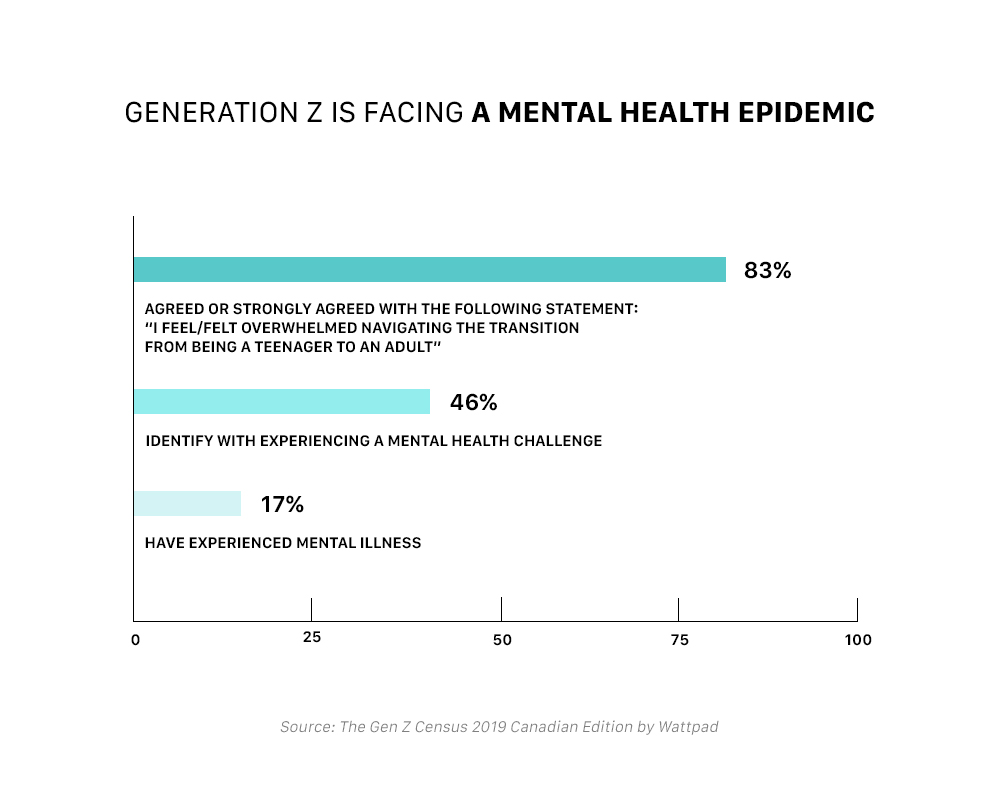
According to the Generation Z Census 2019 (Canadian Edition) data, people aged 10-24 born between 1995-2009, are facing a mental health epidemic. The report shows that 46% of Gen Z identify with experiencing a mental health challenge, and 17% have experienced mental illness.
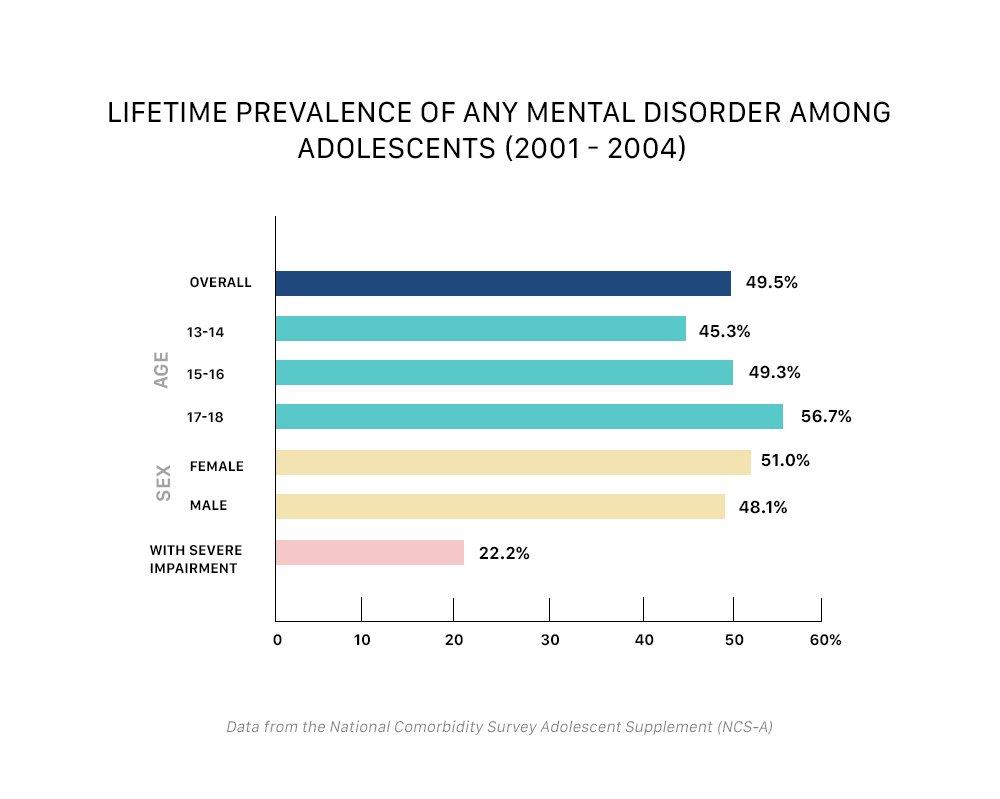
Moreover, the National Comorbidity Survey Adolescent Replication Supplement (NCS-A) estimates that the lifetime prevalence of any mental disorder among adolescents increases gradually with age.
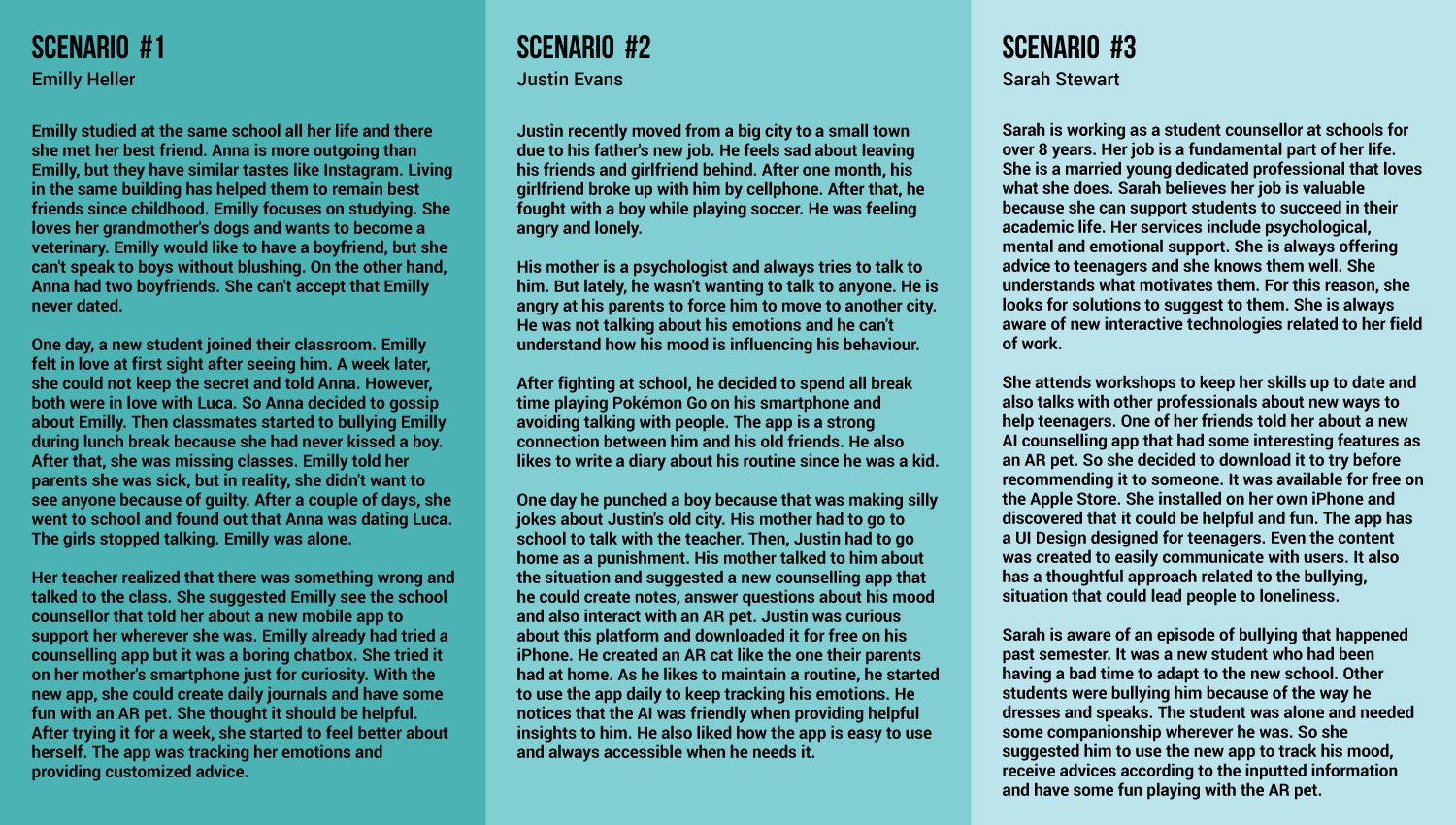
Target Audience, personas and scenarios
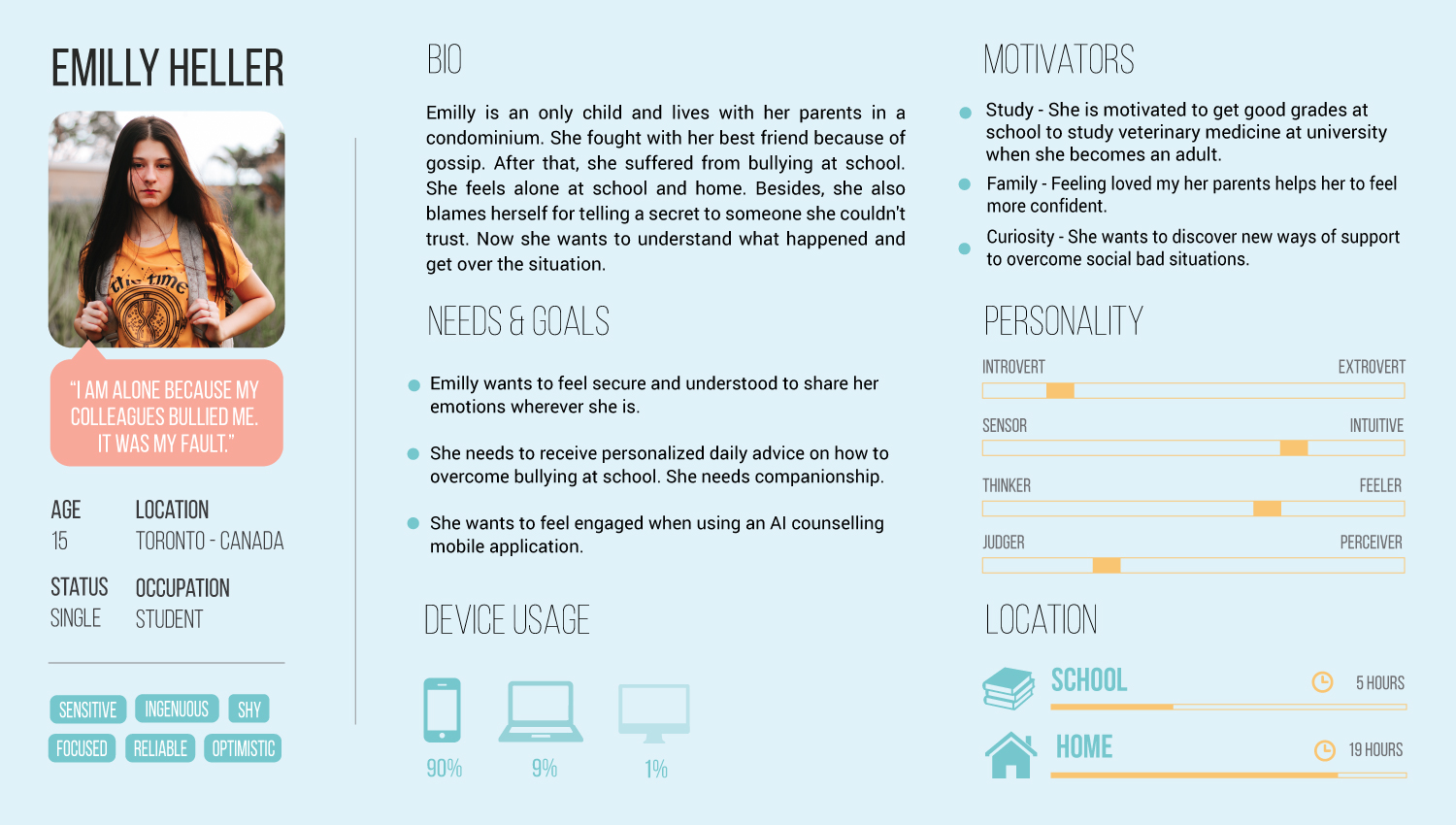
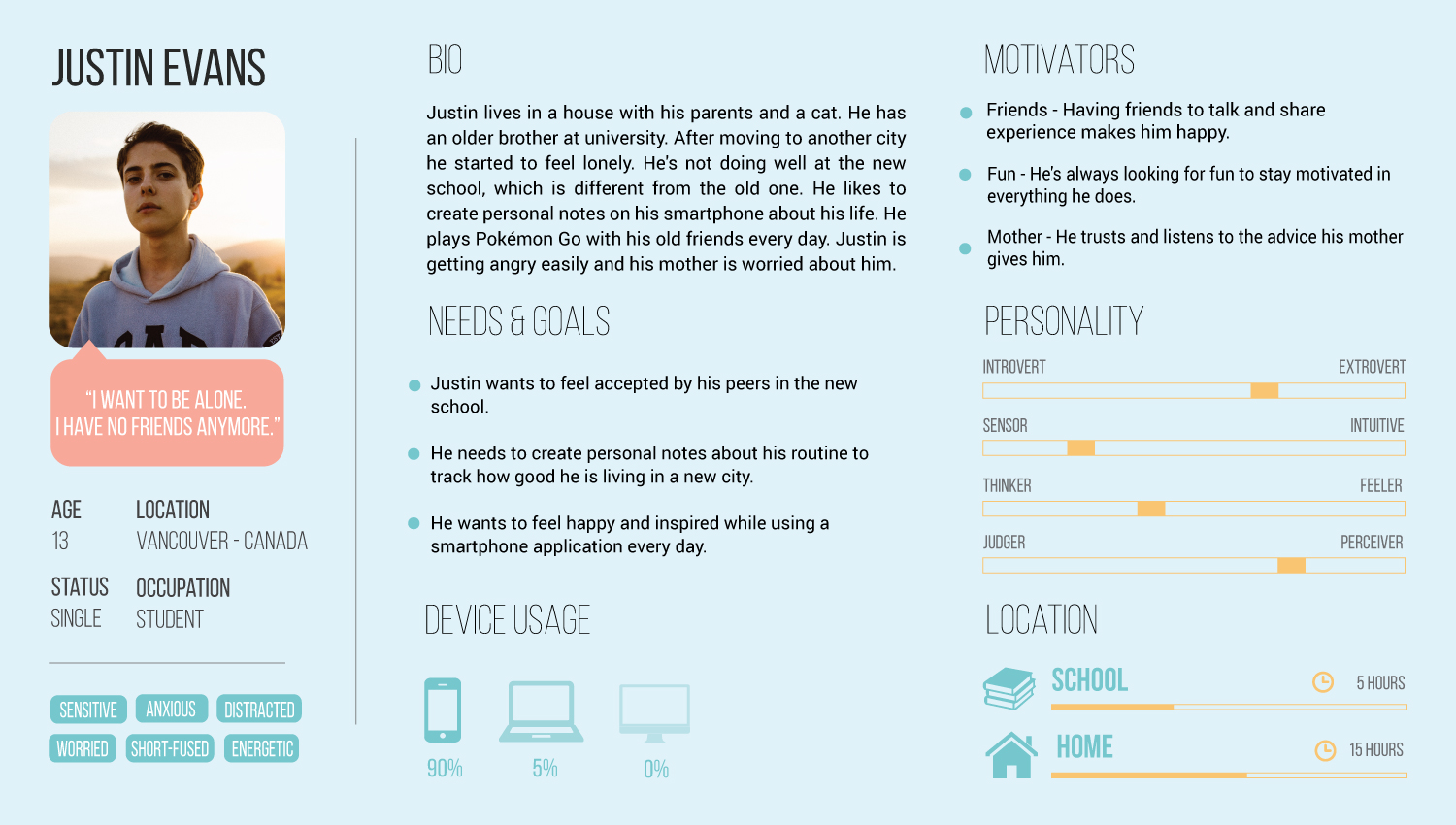
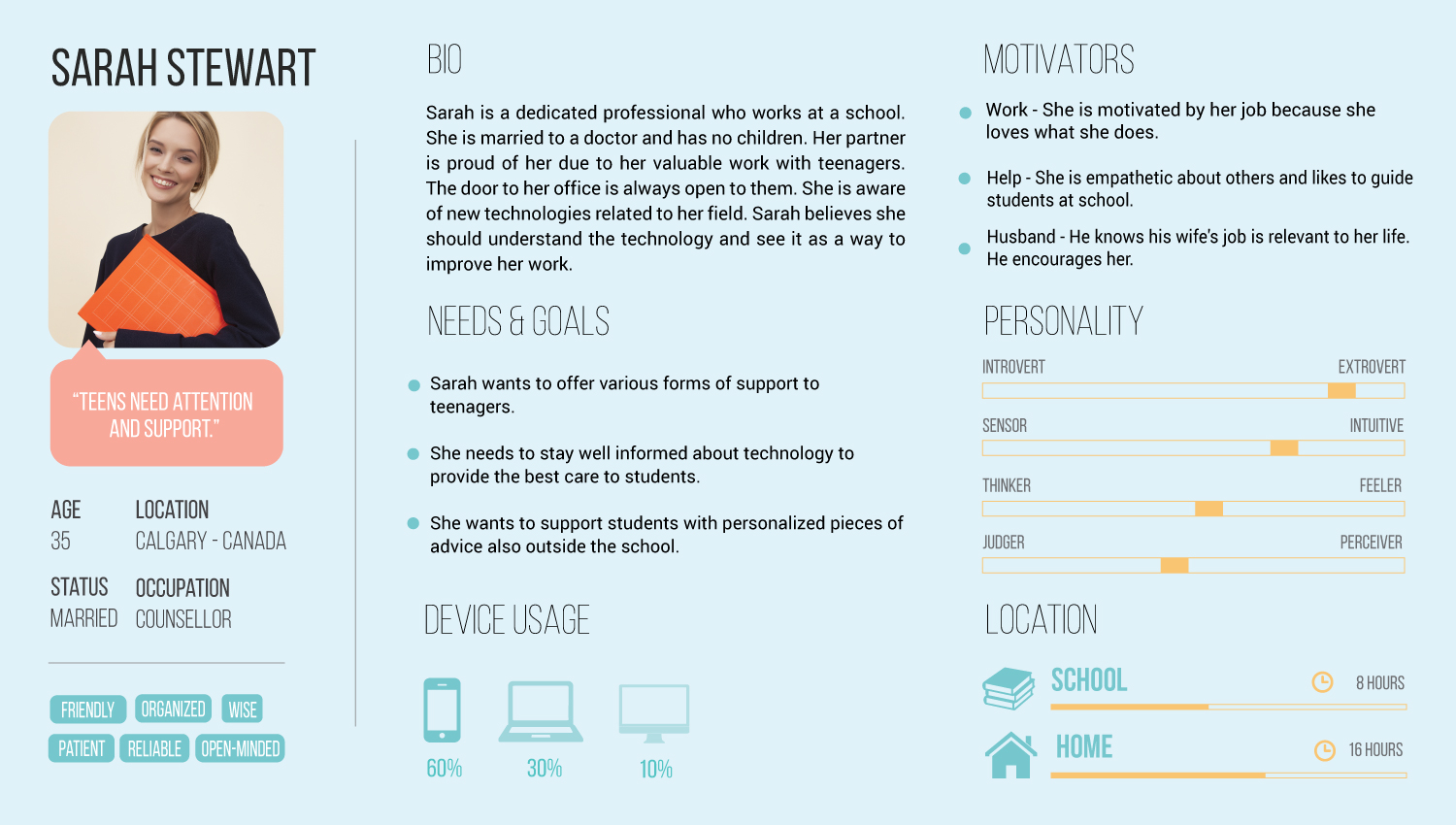
Adolescents from 13 to 15 years old, iPhone users, English speakers of any gender, any nationality and facing an emotional/mental health situation.
User Research for concept validation
I surveyed 15 people to validate the first concept of the platform and all participants had emotional or mental health problems during adolescence.
Insights
Affordability and stigma are some of the important barriers preventing people from seeking out the help they need.
A virtual pet is interesting, but how it can really help someone facing sensitive situations?
What methodology is the best for virtual therapy? And another concern is Concern data privacy.
Content validation
I conducted an interview with Elaine Botelho, a Brazilian psychologist that volunteered to help me validate content. Below are some of the questions and answers:
Q: Can a mobile app cooperate to improve a person’s emotional health? Why?
A: I believe so. I understand that it is difficult to exhaust the reasons, but I mention the difficulty of some people in “opening up” to others talking about their pain. Initial impersonality, oddly enough, can be a facilitator for this process.
Q: What triggers should the app not have?
A: I cite as the main one to be avoided that of proposing to replace the reasoned therapies.
Q: Do you think the application should ask users to specify the bad/difficult situation they are going through? If so, what situations?
A: I think that this request should not be formulated directly, I say this because it is usually not easy for teenagers to deal with painful situations. There is a need to build a relationship of trust so that such matters are addressed and treated. My biggest concern is, touching on these issues, fomenting emotional pain and leaving it open, without proper treatment or direction.
Q: It is important to engage users to use the app at least once a day. Do you think 5-minute questions or activities are appropriate? Why?
A: Yes, I think it’s super appropriate. I think that the proposals for activities really shouldn’t be too long, since adolescence tends to be marked by impatience and anxiety, so something that demands a lot of time can bore them and lead to withdrawal. I also think that activities can include rewards, challenges … proposals that instigate and stimulate adolescence.
Read the interview by clicking here.
Definition
First concept:
The main goal of the project is to provide a safe environment for teenagers to get to know themselves better. The product could be a smartphone app featuring a virtual pet for companionship.
Updated concept after concept validation:
The goal of the project is to provide a safe environment for teenagers to share their data, aiming to know themselves better after some time. The product could be a counselling app that uses artificial intelligence to generate reports based on users’ answers to sensitive questions. A dog would be the app’s mascot. Its mission would be to interact with, lighten the matter and entertain teens.
Market Research
I looked into five counselling platforms during a comparative analysis. Some were mentioned during user research. Understanding how these platforms offer virtual therapy and generate reports helped me to identify common feature patterns.
Findings and Opportunities:
- Friendly mascots are commonly present in counselling apps.
- Counselling platforms depend on constant use.
- Propose users take action.
- Some entertainment helps to increase retention.
- Data security is crucial. Protecting and giving people control over their data too.
- Psychological terms need to make sense.
- How to think outside of the box? How do explore opportunities counselling platforms are missing?
Problem
How can an interactive platform help teens to understand their feelings and identify behaviour patterns?
Ideation
I recruited two participants for my in-person brainstorming session. We decided to add more than one feature — 5-minute questions, a mood tracker, interactive pet.
Solution
I proposed BetterYou: An innovative iOS mobile app that combines emerging technologies to gather teens’ responses to generate customized reports.
AI counselling apps are emerging around the world. These apps can use Cognitive Behavioral Therapy (CBT) to formulate questions and they are considered a short-term treatment that focuses on the way people react to things that happen to them.
A study published in the World Psychiatry journal in 2014 compared people who received CBT treatment online with those who received it personally. The result showed that both forms were equally effective.
Low-Fidelity Explorations
I built a low-fidelity wireframe of 33 screens using Adobe XD. This wireframe was tweaked three times after being tested by volunteers.
Main User Flows:
Daily check-in: Tap the “Check in” CTA button on the home screen > Choose from anxiety, sadness, bullying, post-traumatic stress, lighting, disappointment in love or none > Answer 4 related questions> Confirmation screen, tap next > Home screen.
Record mood: Tap “Mood” in the navigation bar > Select one option: morning, midday or evening/night > Choose the intensity of your mood (very good, good, moderate, bad and very bad), tap next > Confirmation screen.
Create a virtual pet: Tap “Pet” in the navigation bar > Create new pet > Pick a name, chose between dog or cat > choose pet color and tap next > Interact with your pet by giving it virtual treats, playing with a virtual ball, and training it to sit or jump.
Medium Fidelity Flow Explorations
The core function and mood tracker became one because most users felt confused.
Based on the suggestion of Elaine, the physiologist, I created the Challenges. This way, one can take action and improve mood.
And for the AR pet, people asked me to add different animals. However, doing that would generate constraints regarding requirements. All screens of the app would need to reflex the change. So, the AR pet became just a dog named Boo that can be stylized with fun accessories.
Interact with the prototype here.
Testing & Iterations
Usability Testing
A total of 6 users went through the prototype’s low-fi and mid-fi versions to run through the tasks. I went ahead with the screen version which led to a higher task completion rate.
Proposed tasks
1 Complete daily check-in
User Flow: Navigate to the home screen > Tap the “Check in” CTA button > Choose from anxiety, sadness, bullying, post-traumatic stress, lighting, disappointment in love or none > Answer 4 related questions > Confirmation screen.
2 Record your morning mood
User Flow: Tap “Mood” in the navigation bar > Select one option: morning, midday or evening/night > Choose the intensity of mood (very good, good, moderate, bad and very bad) > Confirmation screen.
3 Create a virtual pet
User Flow: The interaction with Boo (mascot) happens when a user taps “Pet” in the navigation bar > Chose from AR Mode or Quick Play > Interact with the dog by giving virtual treats, playing with a virtual ball, and asking him to sit or jump.
Tweaks
After user testing, I recognized a theme: The pet needed to be more relevant and I added it to almost all screens. The content was also reviewed to be less explicit. Technical terms needed to be explained. To avoid triggers, the copy was reviewed by a volunteer psychologist.
I explored a different form of making the mascot more relevant. I also tweaked the content, and a volunteer psychologist proofread it.
"Daily Check-in" including a pop up window
Mood Tracker including confirmation screen and monthly stats
High Fi Prototype
Interact with the prototype here.
iOS User Interface Elements
Typography, Iconography and components based on Apple’s UI Design kit.
Metrics
Revenue
I explored some ideas to make this app generate a profit. It would generate revenue when users sign up for a premium account. Paying to use the app gives them more reports, more mood challenges and more pet customizations. Premium plans start at CAD$4.99 (+tax) per month or CAD$44.99 (+tax) annual fee.
Trinity Strategy
It is based on behaviour, result and experience. People use the app because of the need for emotional support combined with self-awareness through cognitive therapy.
They want to have a meaningful experience that makes a positive impact. The app meets their needs by providing a safe and friendly environment.
Interaction provides an exchange: users provide data to obtain relevant information about themselves after some time. The desired result is to create a premium user base sufficient to cover maintenance and improvement expenses, in addition to generating profit. And that the information obtained by users can help improve their mental/emotional health situation.
Takeaways
Having more time, I would love to conduct more remote or in-person budget-friendly usability tests to refine the prototype. The tests could be the following:
– In-person/virtual interviews with parents of teens regarding their willingness to pay for the app’s premium features.
– Usability Test with a small sample of users using the high-fidelity prototype. Quick tests of Usability Hub: Five Second Test, Click Test, Question Test, Navflow & Preference test.
– User Testing platform: Record the prototype screen, the physical user’s video as he interacts with the app, and audio to record the user’s thoughts/feelings (thinking out loud).
– Testing emotional engagement: Micro-surveys with two to three questions like “Do users feel comfortable answering the following questions?”
What I’ve Learned
I learned more about Apple Design Resources for iOS and iPadOS. I used design templates as a foundation to build my project’s design style guide. It helped me to keep elements consistent.
I also figured out that a real app with two emerging technologies (Augmentative Reality and Artificial Intelligence) is probably too costly. In addition, this app might take up lots of storage and requires a long loading time.
Overall, I would probably make it simpler by removing extra features and focusing on fewer user flows.